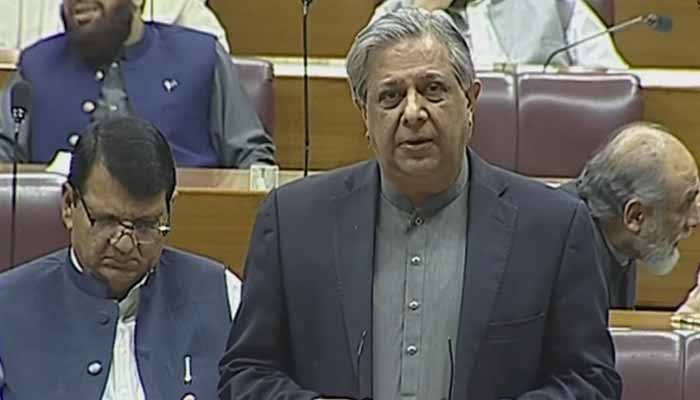
ISLAMABAD: Law Minister Azam Nazeer Tarar on Tuesday tabled the 27th Constitutional Amendment Bill in the National Assembly, a day after the Senate passed the landmark legislation with a two-thirds majority amid a walkout by opposition parties.
The bill, comprising 59 clauses, proposes sweeping reforms in Pakistan’s judicial and military structures. It secured 64 votes in favour in the 96-member upper house, with no votes against due to the opposition’s boycott.
In the Senate, the bill was backed not only by treasury benches but also by ANP senators, PTI-backed Saifullah Abro, and JUI-F’s Ahmed Khan. In a surprise move, Abro abstained from joining the protest and later announced his resignation from the Senate.
The National Assembly session, scheduled to begin at 11:00am, commenced half an hour late. Lawmakers offered prayers for PML-N Senator Irfan Siddiqui, who passed away the previous night.
‘Bill Passed with Two-Thirds Majority,’ Says Tarar
Introducing the bill, Law Minister Tarar told the house that the Senate had approved the amendment with a two-thirds majority.
“The opposition should have participated in the joint parliamentary committee sessions to make constructive contributions,” he said.
As Tarar spoke, opposition members staged a loud protest, chanting slogans against the bill and the government.
Explaining the reform package, the law minister said that the amendment introduces constitutional benches for major legal cases and removes suo motu powers from the judiciary.
“Worldwide, constitutional matters are decided by designated benches. In Pakistan too, we have established proper procedures for judicial appointments and powers,” he said.
He added that judicial transfers would now be managed by a judicial commission, which would include five Supreme Court and Federal Constitutional Court judges, and two members each from the government and opposition.
“If a judge refuses a transfer, they will be considered retired,” Tarar clarified.
The new Federal Constitutional Court (FCC) would handle constitutional and provincial disputes, while the Supreme Court would focus on civil and criminal matters, he added.
Military and Presidential Reforms
The law minister also addressed defence-related reforms, noting that the amendment clarifies the appointment and constitutional role of senior military ranks, including the Chief of Defence Forces and Field Marshal, the latter of which will remain a lifetime title.
“We are bringing these distinctions within constitutional limits while preserving the honour of the armed forces,” Tarar stated.
Discussing presidential immunity, he explained that special exemptions would apply only during a president’s tenure.
“If the president assumes a public office after completing their term, the immunity will no longer apply,” he said.
Tarar urged lawmakers to engage in serious debate rather than confrontation.
“Out of 59 clauses, 47 relate to the establishment of the Federal Constitutional Court. Constructive suggestions from the opposition are welcome,” he said.
Opposition Terms Reforms ‘Baku Amendments’
Addressing the house, PTI Chairman Barrister Gohar Ali Khan rejected the amendment, calling it a “day of mourning for democracy.”
“These are not constitutional reforms — they are the Baku Amendments,” Gohar said, in reference to Prime Minister Shehbaz Sharif’s visit to Azerbaijan when the federal cabinet approved the draft.
He alleged that the changes were designed to benefit certain individuals and undermine accountability.
“We make laws and then take exemption from them. Are we creating an elite class that stands above the law?” he asked.
Gohar criticised the removal of the Chief Justice of Pakistan’s title, saying it had been “replaced with Chief Justice of the Supreme Court.” He argued that the bill was rushed through with minimal dissent and lacked public consultation.
“When the PDM first came to power, it amended the NAB Ordinance to save itself. Now it seeks to rewrite the Constitution,” he remarked.
The PTI leader also questioned ongoing corruption cases against President Asif Ali Zardari, urging transparency and adherence to the rule of law.
“Being answerable to the Constitution and the law is the essence of democracy,” he said.
Key Highlights of the 27th Constitutional Amendment
-
Federal Constitutional Court (FCC) to be established with equal provincial representation
-
Supreme Court’s powers curtailed, some transferred to the FCC
-
FCC empowered to take suo motu notice upon petitions
-
Islamabad High Court to have one representative on the FCC bench
-
Chief of Army Staff to assume the role of Chief of Defence Forces
-
Field Marshal, Marshal of Air Force, Admiral of Fleet titles to remain lifetime honours
-
Judicial Commission to oversee judge transfers; refusals lead to retirement
-
Presidential immunity ends if president assumes public office after tenure
-
Judges must serve five years in high courts to qualify for FCC appointment
-
President and prime minister to jointly oversee judicial appointments