The lights hadn’t even dimmed when the warning arrived. “Intense violence will be shown,” the writer announced before the play began. It was less a disclaimer and more a challenge. Anyone uneasy with what was coming could leave. Most stayed.
What followed over the next 55 minutes was Dreams of Ithaca — an absurdist plunge into unease, disorientation, and quietly growing dread. Staged at the Arts Council of Pakistan Karachi as part of the World Culture Festival, the production has quickly earned a reputation for being one of the boldest theatrical experiments seen this year.
A journey built on confusion, humour, and fear
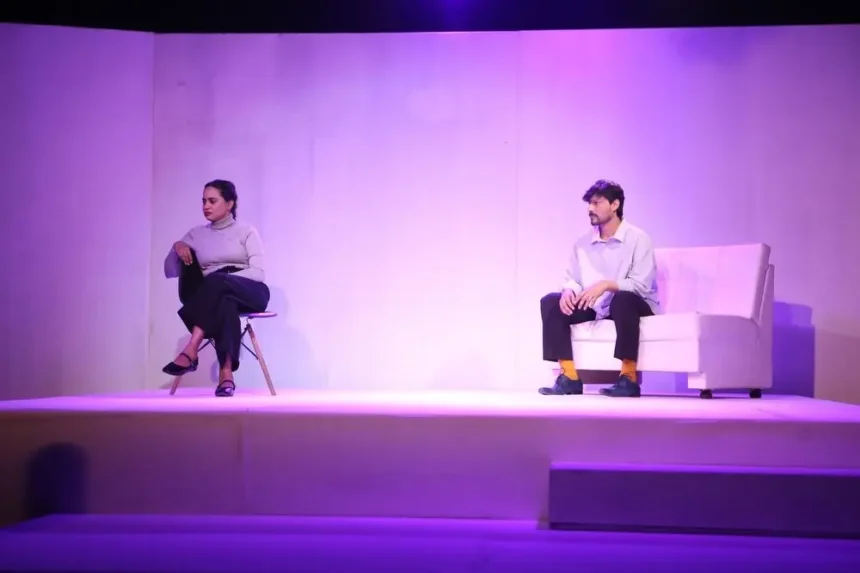
The play, written by Fawad Khan (not the actor) and directed by Sonil Shankar with Urdu adaptation by Kulsoom Aftab, refuses to tell a tidy story. Instead, it drops audiences into the lives of two unnamed characters, a man and a woman, whose bickering starts out harmless — petty irritations, mismatched rhythms, strange dialogues that loop back on themselves.
Then something shifts. A signal light appears. Mundane at first. Harmless. And then the scene unravels. The red light becomes a symbol of everything that traps them: frustration, fear, an unnameable kind of existential paralysis. Violence breaks through the surface with no warning. The mood switches from comedy to horror in a heartbeat.
Audience members weren’t just watching absurdism; they were living inside it.
A play that refuses to comfort
Absurdist theatre often deals with the meaninglessness of routine, the strangeness of human behaviour, the chaos beneath ordinary life. Dreams of Ithaca doesn’t flirt with those ideas. It drags you into them.
The two characters spiral through conversations that turn sharp, unsettling, strangely funny, then suddenly cruel. At times the tension is so thick that people in the hall reportedly stopped breathing for a moment, waiting for the next emotional swing.
Nothing feels stable. Not the characters. Not the stage. Not even the audience’s sense of what is real within the performance.
Why people are talking — and why some left early
The production’s intensity has sparked divided reactions.
Some viewers praised it as fearless, saying they hadn’t seen anything this psychologically raw on a Pakistani stage in years. Others called it disturbing, even overwhelming.
The creators seem entirely unbothered by the discomfort, perhaps even encouraged by it. The play isn’t meant to soothe. It isn’t trying to teach a clear moral lesson or wrap its themes neatly with a bow at the end. Instead, it sits with ambiguity: What is home? Where do we belong? Why do small fears grow into monsters when no one is looking?
The ending offers no answers. Just more questions.
A bold moment for local theatre
For Karachi’s theatre community, Dreams of Ithaca is a reminder that audiences here are ready — maybe even hungry — for work that’s challenging, surreal, and emotionally risky.
It pushes the boundaries of what mainstream theatre typically attempts, leaning into discomfort rather than avoiding it.
Is it enjoyable? That depends on your tolerance for chaos. But is it memorable? Absolutely.
There’s a reason critics keep repeating the same phrase: this play is not for the faint of heart.