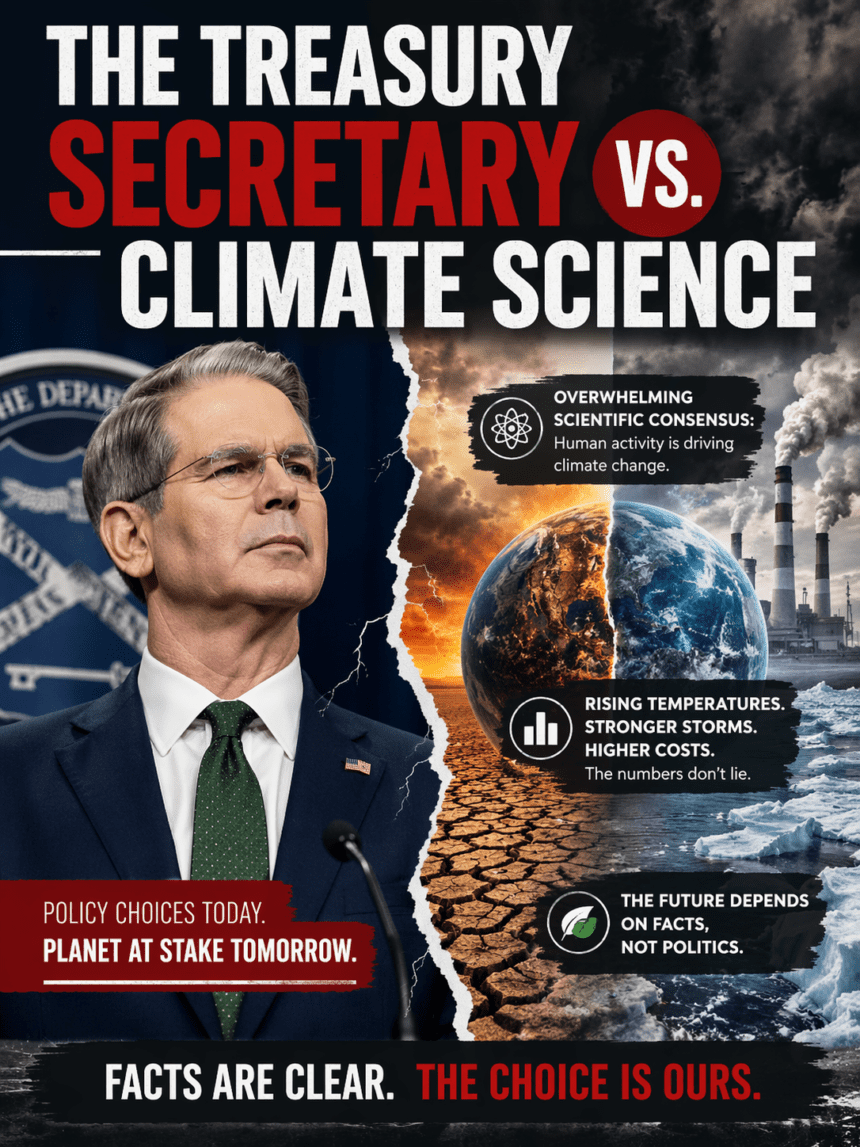
The clash is no longer subtle. U.S. Treasury Secretary Scott Bessent has been pushing major international financial institutions to pull back from climate work and return to what he calls their “founding missions,” arguing in official remarks that “mission creep” has knocked the IMF and World Bank off course. In a separate January move, the Treasury Department also announced the United States’ immediate withdrawal from the Green Climate Fund, with Bessent saying Washington would no longer fund the body and would step down from its board seat.
That is the policy side of the story. The scientific side looks very different. NASA says the evidence continues to show that human activities, primarily the burning of fossil fuels, have warmed Earth’s surface and oceans, and that warming trends over the past century are extremely likely to be due to human activities. Its summary of the literature also points to an overwhelming scientific consensus on human-caused climate change.
So the real tension here is not simply about budget priorities or institutional focus. It is about whether climate change is treated as a core economic risk or pushed to the margins as a distraction. Bessent’s public line has been that multilateral lenders should focus more narrowly on macroeconomic stability, poverty reduction and traditional development goals. Critics, though, see that as a false separation. Climate shocks are already hitting growth, debt, food systems, insurance markets and infrastructure, which means they are not some side issue parked neatly outside economics.
That is why the fight matters beyond Washington language games. When the Treasury secretary pressures the IMF and World Bank to de-emphasize climate, he is not merely changing talking points. He is helping shape what the world’s most powerful financial institutions will count as urgent, financeable and real. And once that happens, the consequences spill outward fast, especially for poorer countries that are already dealing with rising heat, floods, drought and energy stress.
There is, of course, a political logic behind Bessent’s approach. The administration is framing “affordable, reliable energy” as the foundation of growth and poverty reduction, and it is clearly wary of international climate mechanisms it sees as ideological or overreaching. That message will resonate with people who think multilateral institutions have become too sprawling and too activist. But it still runs headfirst into a problem that does not care about ideology: the science has not moved to meet the politics. The politics have moved away from the science.