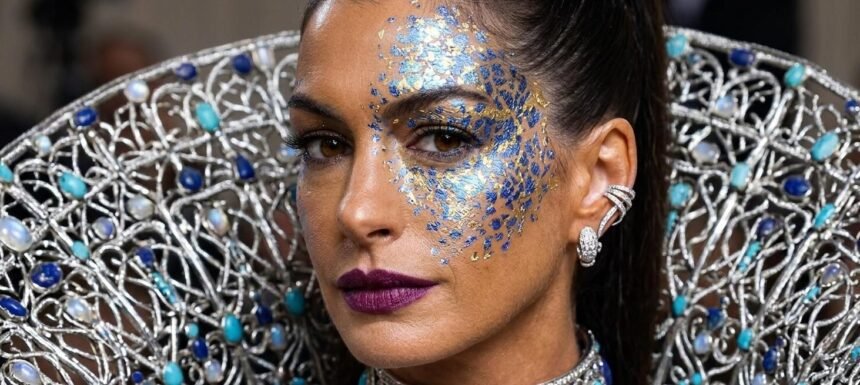
Anne Hathaway is back in darker, stranger territory with Mother Mary, a new David Lowery film that casts her as a world-famous pop icon coming apart just as she tries to stage a comeback. The film, released by A24, opened in limited U.S. release on April 17, 2026, before expanding wide on April 24. Michaela Coel co-stars as Sam Anselm, the estranged designer and former confidante pulled back into Mary’s orbit at a moment when almost everything in the singer’s life appears to be fraying.
What makes the role stand out isn’t just the glamour or the obvious tabloid-energy of the setup. It’s the way Hathaway seems to have approached the character almost like a full physical rebuild. In recent interviews around the film’s release, she said she spent years working on the voice and movement needed to play Mother Mary convincingly, not as a generic superstar but as someone carrying pressure, ego, fear and damage all at once. Reuters reported that Hathaway put in long-term vocal and dance preparation for the part, while Entertainment Weekly said she trained up to eight hours a day for one especially intense dance sequence.
In the film, Mother Mary is introduced on the edge of a major return performance after a mysterious incident throws her world off balance. She then travels to England to seek out Sam, the one-time creative partner she cut out of her life years earlier, asking for a dress that can somehow express who she is now. That reunion, of course, is not neat and it’s definitely not warm. Old resentments rise fast, and the film turns into something more intimate and more unsettling than a standard backstage music drama.
There’s also a lot of curiosity around what kind of movie Mother Mary actually is. On paper, it sounds like a pop melodrama. In practice, early coverage and reviews describe something weirder: part psychological breakdown, part creative reckoning, part ghost story of fame. Decider described it as a visually striking drama about friendship, mental health and healing, while other coverage has emphasized the film’s eerie, stylized mood and the unstable emotional space between Hathaway and Coel’s characters.
The music angle has added another layer of intrigue. The film’s original songs were developed with contributions from Jack Antonoff and Charli XCX, and reports tied to the release noted that Hathaway performs songs connected to Mother Mary’s stage persona. That matters because the performance here doesn’t seem to be built on imitation alone. She isn’t simply “playing a singer.” She’s trying to inhabit the machinery of pop stardom: the polish, the theatricality, and the loneliness underneath it.
For Hathaway, it’s one of those roles that could easily have tipped into parody. A troubled megastar in couture, collapsing under the weight of image and expectation, is familiar material. But the early response suggests Mother Mary is aiming for something less obvious and more unnerving. Whether audiences fully go with Lowery’s vision is another question, but one thing seems clear already: Hathaway didn’t play this safe. She went all the way in.