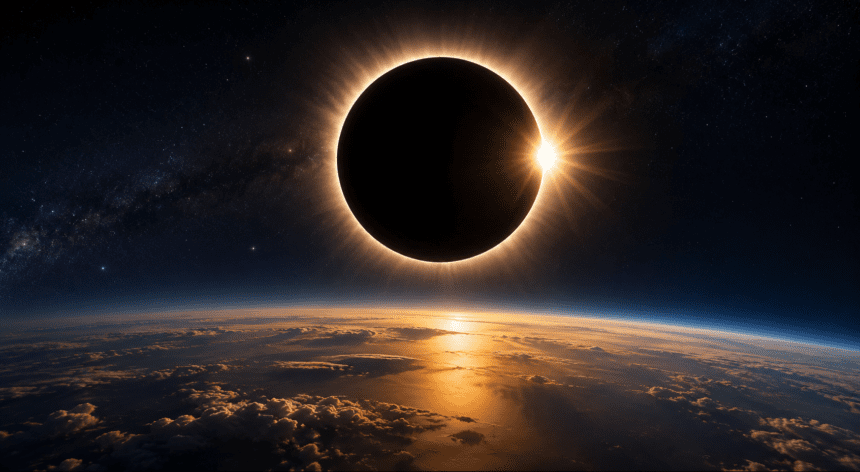
Earth will not lose total solar eclipses anytime soon — but the clock is already ticking. Scientists say the Moon is slowly moving away from our planet, and one day it will appear too small in the sky to completely cover the Sun. When that happens, total solar eclipses will vanish from Earth forever.
For now, humanity is living in a rare cosmic window. The Sun is about 400 times wider than the Moon, but it is also about 400 times farther away, which makes both objects look almost the same size from Earth. That near-perfect visual match is what allows the Moon to fully block the Sun during a total solar eclipse, turning day into twilight and revealing the Sun’s glowing corona.
But the match is not permanent. The Moon is gradually drifting away from Earth at roughly 4 centimeters, or about 1.5 inches, per year. It sounds tiny — and honestly, it is — but across hundreds of millions of years, that slow movement changes the geometry of eclipses. As the Moon moves farther away, its apparent size in the sky shrinks. Eventually, even when it passes directly in front of the Sun, it will no longer be large enough to cover the solar disk completely.
The commonly cited estimate is that Earth’s final total solar eclipse will occur about 600 million years from now. After that, solar eclipses will still happen, but they will mostly be annular or partial. In an annular eclipse, the Moon sits in front of the Sun but leaves a bright “ring of fire” around its edges. Beautiful, yes — but not the same as totality.
There is some scientific debate around the exact timing. A more recent calculation, which includes the Sun’s slow increase in apparent size as it evolves, suggests the last total solar eclipse could happen much earlier — around 246 million years from now. That estimate is not the standard public-facing number, but it shows why the answer is not as simple as one date circled on a calendar. The Moon’s distance, Earth’s orbit, the Sun’s changing size and eclipse geometry all matter.
Still, nobody alive today needs to worry about missing the final chapter. Total solar eclipses remain part of Earth’s future for many millions of years. In fact, upcoming total solar eclipses are already on the calendar: one will be visible on August 12, 2026, across Greenland, Iceland, Spain, Russia and a small part of Portugal; another will cross parts of southern Spain, North Africa, Saudi Arabia and Yemen on August 2, 2027.
A total solar eclipse does not happen every month because the Moon’s orbit is tilted compared with Earth’s orbit around the Sun. Only when the Sun, Moon and Earth line up in just the right way does the Moon’s shadow fall on our planet. That is why eclipses come in seasons, and why totality is visible only from a narrow path on Earth’s surface.
So, the dramatic headline is true — but only on a cosmic timescale.
Total solar eclipses are disappearing. Not tomorrow. Not in a thousand years. But far in the future, Earth will see its last moment of daytime darkness, and after that, the Moon will never fully cover the Sun again.