UNITED NATIONS — July 8, 2025:
Pakistan has warned the United Nations that terrorism emanating from Afghanistan continues to pose a serious threat to its neighbors, particularly Pakistan itself, and called on the international community to hold the Taliban accountable to their international commitments.
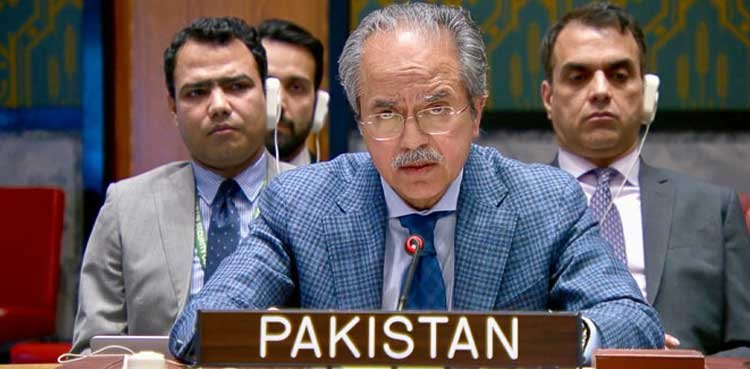
Addressing the UN General Assembly during a high-level debate on the situation in Afghanistan, Pakistan’s Permanent Representative to the UN, Ambassador Asim Iftikhar Ahmad, urged global powers to “speak with one voice” and press the de facto Afghan authorities to prevent the use of Afghan territory for terrorist activities against any country.
“We continue to see attempts by TTP terrorists to infiltrate into Pakistan from Afghanistan,” the ambassador said, highlighting evidence of operational collaboration between the Tehrik-e-Taliban Pakistan (TTP), Balochistan Liberation Army (BLA), and its Majeed Brigade to target Pakistan’s strategic infrastructure and economic development projects.
The warning came as the 193-member UN General Assembly adopted a resolution — supported by 116 countries — demanding that Afghan territory not be used as a safe haven for terrorism and urging the Taliban to uphold human rights, international law, and their prior commitments. Pakistan voted in favor of the resolution, while India abstained, and the United States and Israel voted against.
The resolution expressed “serious concern” about the continued presence of terrorist organizations in Afghanistan, including Al-Qaeda, ISIS/Daesh and its affiliate ISIL-Khorasan, as well as TTP. It also condemned the systematic oppression of women and girls, urging the Taliban to reverse their restrictive policies on education, employment, and public participation.
Security and Humanitarian Crisis Deepening
Ambassador Asim Iftikhar noted that despite the end of fighting in Afghanistan, the country remains gripped by despair, poverty, and instability. “Afghan people continue to suffer — under sanctions, a dysfunctional banking system, and a worsening humanitarian situation. Terrorism, narcotics, and human rights abuses have only exacerbated their plight,” he told the Assembly.
He reiterated that Afghan soil continues to serve as a launchpad for terror attacks against Pakistan, warning that the TTP — with an estimated 6,000 fighters — is the largest UN-designated terrorist group currently operating from Afghanistan. “Cross-recruitment between TTP and ISIL-K threatens not only Pakistan but regional and global stability,” he added.
The ambassador also revealed that advanced weaponry left behind by international forces has been seized by terrorists and used in sophisticated attacks against Pakistan, including in recent weeks. “These incidents highlight the scale of the threat. Pakistan will take all necessary measures to safeguard its people,” he asserted.
Call for Balanced Engagement and Economic Revival
Ambassador Iftikhar emphasized the need for a balanced and comprehensive engagement strategy with the Taliban, warning against the dangers of isolation. “What could not be achieved by force cannot be secured through sanctions or financial coercion,” he said. “This approach risks renewed violence, deeper poverty, and another wave of displacement that none of Afghanistan’s neighbors can absorb.”
He expressed support for UN-led initiatives, such as the Doha Process, aimed at structured dialogue with the Taliban, and stressed the need to avert a humanitarian catastrophe. He warned that the 2025 Humanitarian Needs and Response Plan remains critically underfunded, with only 15.7% of the $2.42 billion goal met.
Support for Afghan People and Regional Connectivity
Highlighting Pakistan’s longstanding role in hosting Afghan refugees, the envoy said that since August 2021, an additional one million undocumented Afghans had entered Pakistan, straining resources and posing security challenges. He urged the international community to share this burden more equitably.
Ambassador Iftikhar also called for the revival of Afghanistan’s banking sector and economy, including the unfreezing of Afghan financial assets held abroad. He reaffirmed Pakistan’s commitment to regional connectivity projects such as TAPI (Turkmenistan-Afghanistan-Pakistan-India pipeline), CASA-1000, the Uzbekistan-Afghanistan-Pakistan railway, and the extension of the China-Pakistan Economic Corridor (CPEC) into Afghanistan.
“Afghanistan must not become a safe haven for terrorism against any country,” he said, adding that spoilers — both internal and external — must be prevented from undermining peace and stability in the region.
On Human Rights and Education
On the issue of women’s rights, Ambassador Iftikhar expressed “serious concern” over Taliban restrictions on women and girls, calling such measures incompatible with international norms and Islamic values. He noted that Pakistan continues to support educational opportunities for Afghan youth, with over 4,500 Afghan students currently studying in Pakistan — one-third of them girls.
“The only viable path to a peaceful, stable, and inclusive Afghanistan lies in sustained engagement, regional cooperation, and global responsibility,” the Pakistani envoy concluded.