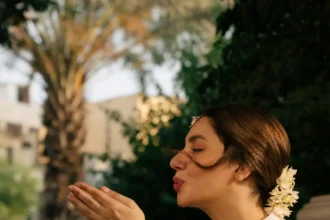


Meesha Shafi’s latest album, Khilnay Ko, has officially stepped onto the global stage, landing submissions for consideration in three major Grammy categories. For an artist who has consistently refused to shrink herself, this feels like a moment shaped as much by defiance as by creativity.
Released earlier this year, Khilnay Ko is a deeply personal, 11-track project that blends vulnerability with rebellion. Instead of offering the familiar pop-folk fusion many expected, Shafi delivered something far more intimate — a sonic journal that traces her emotional and artistic rebuild over the last few years.
A Different Kind of Album — and a First for a Pakistani Woman
Shafi has said openly that she doesn’t know “any woman in Pakistan who has done what I did,” and she’s not exaggerating. The album turns years of harassment, court battles, media pressure and public scrutiny into art — raw, unsettling, and beautifully crafted.
Critics have described Khilnay Ko as “a multimedia diary,” a space where she lets in the tremors, pauses and cracks that many artists edit out. The music stretches across Urdu and English, mixing electronic texture with South Asian melodies, and leaning into a mood that is reflective more than performative.
Three Grammy Categories in Play
The album has been submitted for the 2026 Grammy Awards in:
-
Best Global Music Album
-
Best Global Music Performance
-
Best Engineered Album (Non-Classical)
That last one — engineering — is especially notable. It highlights the album’s detailed sonic design, something Shafi and her team have stressed from the start.
A Statement of Survival, Not a Comeback
While some have framed the album as a comeback, Shafi has rejected that idea outright. Khilnay Ko, she says, is not a return — it’s a continuation. A re-rooting. A way of reclaiming artistic space after years of feeling pushed out of it.
The themes are unmistakable: surviving digital harassment, confronting misogyny, rebuilding confidence, and refusing to be erased from public life. Rather than hiding behind metaphor, Shafi lets the truth sit plainly inside her lyrics and production.
A Boost for Pakistan’s Global Music Footprint
Shafi’s submission aligns with a growing trend: Pakistani indie musicians stepping confidently onto the international stage. She is joined this year by Arooj Aftab, another globally recognised Pakistani artist also in Grammy contention.
Together, their submissions mark a moment where Pakistan’s music scene — often overshadowed by Bollywood and Western markets — is carving out its own identity in the global industry. Independent artists from the country are seeing rising international streams, festival bookings, and cross-border collaborations.
What Happens Next?
The first round of Grammy voting is already underway, and the next few months will determine whether Khilnay Ko advances to the official nominations list. Regardless of the outcome, the album has already shifted expectations of what Pakistani artists — especially women — can do on the world stage.
For now, Meesha Shafi stands exactly where the album promised she would: not returning, not retreating — but blooming, on her own terms.