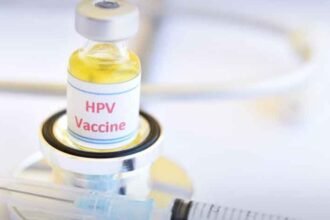


Despite the HPV vaccination campaign in Sindh launched to protect girls from cervical cancer failing to produce the desired results, the Sindh government has still allocated Rs 797 million for the procurement of the vaccine.
The allocated funds will be used to purchase vaccines for the next three years. The HPV vaccine will be included in the children’s Expanded Program on Immunization (EPI) from 2026.
The vaccination campaign was launched across Karachi and Sindh in September for 15 days, but most parents refused to allow their daughters to receive the vaccine due to mistrust. The campaign aimed to vaccinate 4.1 million girls aged 9 to 15 years across the province, but the target could not be achieved. The majority of schoolgirls in both public and private institutions also refused the vaccine, which was provided by an international organization.
Sources said the government plans to include the HPV vaccine in the EPI program based on the campaign’s outcomes. However, the campaign in Karachi failed to meet expectations.
According to EPI statistics, the vaccination rate in Karachi’s Keamari district remained only 16 percent. Most parents refused to let their daughters, even those attending schools, receive the vaccine. Similarly, turnout at fixed centers and other vaccination points was also very low.
Although the EPI claimed the campaign was successful, the situation on the ground told a different story. The major reason for the failure was the lack of response from parents despite promotional campaigns launched by the health department.
The government attempted to raise awareness about the vaccine’s benefits, but its message was ineffective. Anti vaccine groups ran a negative campaign on social media, including AI-generated videos, which spread fear among parents.
In Karachi’s Keamari district, only 16 percent of the 154,632 girls aged 9 to 15 received the vaccine. In the East district, only 37 percent of the 291,552 eligible girls were vaccinated. Similarly, 39 percent of 173,772 girls in the South district and 42 percent of 284,976 girls in the Central district received the vaccine.
These figures were released by the EPI program under the health department. However, most parents ignored the campaign altogether and refused to allow vaccination in schools.
The international organization GAVI had provided 13 million free vaccine doses to the government of Pakistan, with a target of vaccinating 4.1 million girls in Sindh during the campaign.
Sources revealed that the 15 day campaign failed to meet its target, though EPI officials claimed that 65 percent of girls in Sindh were vaccinated. The HPV vaccine has not been introduced in Khyber Pakhtunkhwa or Balochistan.
Medical experts questioned the government’s priorities, pointing out that while diseases like diarrhea, malaria, and dengue claim thousands of lives annually in Pakistan, the government is prioritizing the inclusion of the HPV vaccine in the national immunization program.
Sources further stated that the campaign was conducted as a pilot test before the official inclusion of the vaccine in the EPI program next year. The Sindh government intends to take responsibility for purchasing the vaccine itself.
EPI Project Director Dr. Raj Kumar stated that the Sindh government has allocated Rs 797 million for a three year vaccine supply. Each year, around 700,000 girls aged 9 to 15 will be vaccinated. The funds will cover the procurement of vaccines for three years.
According to Dr. Raj Kumar, while the federal government will handle the purchase, Sindh’s share of Rs 797 million will be paid to the federal authorities. However, a key question arises when parents are unwilling to vaccinate their daughters, why is the Sindh government spending Rs 797 million on purchasing the HPV vaccine?