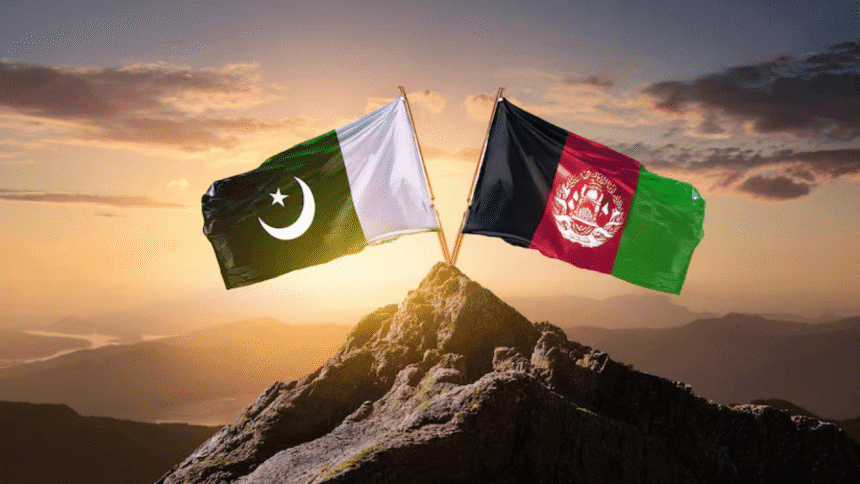
Pakistan’s military has rejected Afghanistan’s claim that armed militants living there are “guests,” calling it an illogical excuse as security forces intensify counterterror operations across the country. The Director General of ISPR, Lt Gen Ahmed Sharif Chaudhry, said Pakistan has conducted 4,910 intelligence-based operations (IBOs) since November 4, killing 206 terrorists, as he briefed senior journalists on national security.
He warned that the Afghan Taliban regime’s support for terrorists poses a threat to Pakistan and the entire region.
Nationwide surge in counterterror missions
Sharing year-to-date data, the DG ISPR revealed that 67,023 IBOs were carried out this year 12,857 in Khyber Pakhtunkhwa and 53,309 in Balochistan. He confirmed 1,873 terrorists killed, including 136 Afghan nationals, saying Pakistan continues to face cross-border threats and criminal networks using rugged terrain to their advantage.
Taliban accused of helping militants cross into Pakistan
Lt Gen Chaudhry highlighted that the Pakistan–Afghanistan border passes through steep mountains, making strict border control extremely difficult without joint responsibility. He accused the Afghan Taliban of facilitating terrorists entering Pakistan and spreading false propaganda against Pakistan’s security forces.
He listed key challenges:
- Suicide attackers often use non-custom-paid vehicles
- Outposts on vulnerable stretches are 20–25 km apart
- Fencing alone is ineffective without posts and fire coverage
- Villages divided across both sides allow undetected movement
- Afghanistan’s border governance is “almost non-existent”
“There is a clear political–terror–crime nexus in border regions,” he said, stressing that Pakistan had provided solid evidence to Afghan authorities about these networks.
“What kind of guests enter armed?” DG questions Taliban
Responding to Kabul’s claim that militants are “guests,” the spokesperson said:
“We have no issue with the Afghan people our issue is with the Afghan Taliban regime.”
He said Afghanistan currently hosts centres of al-Qaeda, Islamic State, and other groups. Pakistan has demanded that the Taliban stop aiding militants and accept a verifiable monitoring mechanism under the Doha Agreement. He added Pakistan would welcome a third-party observer if needed.
US weapons left behind a danger to region
Quoting a SIGAR report, Lt Gen Chaudhry said the US military left $7.2 billion worth of equipment in Afghanistan, now posing a major threat. Any country supplying arms to the Taliban, he warned, is effectively arming terrorists.
Pakistan’s decision to close certain trade routes with Afghanistan, he explained, is based solely on security reasons. He also pointed out that Afghan women half the population have zero representation, undermining the Taliban’s claim to legitimacy.
ISPR hits back at India’s ‘self-deceptive’ military statements
The spokesperson criticised India’s military leadership for misleading claims regarding “Operation Sindoor.” He mockingly said that if India’s “trailer” shows seven aircraft destroyed, 26 sites hit and S-400 systems wiped out, then the “movie” would be a horror film for India. He added these statements are tactics to calm public pressure in India.
Smuggling crackdown and internal reforms
Outlining internal security steps, the DG said:
- Iranian diesel smuggling reduced from 20.5 million litres/day to 2.7 million litres/day
- Profits from smuggled fuel previously funded groups like BLA and BYC
- Under the National Action Plan, 27 districts of Balochistan are now under police control
- Daily community engagements by security forces have reached 140 per day, or 4,000 per month, boosting trust and stability
He warned terrorism cannot be controlled without tackling smuggling, governance gaps, and border crimes.
Foreign run social media networks targeting Pakistan
The ISPR DG also said many toxic X (Twitter) accounts pushing anti-state narratives are run from abroad. These foreign-backed networks, he added, continuously attempt to “inject poison” into Pakistan’s society and politics.
He said it is now “clear” that much of the social media activity inside Pakistan is externally orchestrated.