

It’s happening our Earth is running out of water
The resource that sustains life, fresh water, is disappearing at an alarming rate. According to a new world study envisioned on 22 years of satellite records, large regions of the earth are slowly drying up at an alarming rate and, this will have a ramification that will reform the economy, the food supplies of the world and life itself.
A Global Warning from Space
Over 20 years, U.S.-German GRACE satellites and GRACE-Follow On satellites have monitored the water held by glaciers, rivers, lakes, soils and deep underground aquifers. They have found that this is true and vast areas are losing fresh water. Approximately 6 billion humans, one third to one fourth of the world, live in nations whose water consumption rates exceed nature’s ability to replenish.
Most threatening of all has been the increase in what scientists dub as mega-drying zones-vast belts of land where the supplies of water are drying up every year. One of them extends over the western United States, Mexico, and Central America, and the other over the Middle East and northward to China; several others extend over part of Russia, South Asia and North Africa.
Why the World Is Drying Out
Researchers believe that this crisis is being fueled by two forces:
1. Due to the accelerated evaporation and a change in rainfall, climate change.
2. Known as overpumping of groundwater, farms and cities pump out deposits that had taken thousands of years to accumulate.
Combined, they represent a loss of water so immense it currently adds more to rising sea levels than thawing glaciers.
Figures That Shocked the Scientists
Regions under drying are increasing yearly by a land area equivalent to twice that of California.
The world loses approximately 368 billion metric tons of water each year, or over 10 times the amount held in Lake Mead.
Sixty eight percent of water loss is comprised of groundwater depletion. Canada, Russia, United States, Iran, India are the top countries losing water.
In the Central Valley, California the aquifers are drying up at some of the top in the world, with the next being the Indus Basin of India and Pakistan, the next being the Arabian Peninsula aquifers.
What happens when water runs out
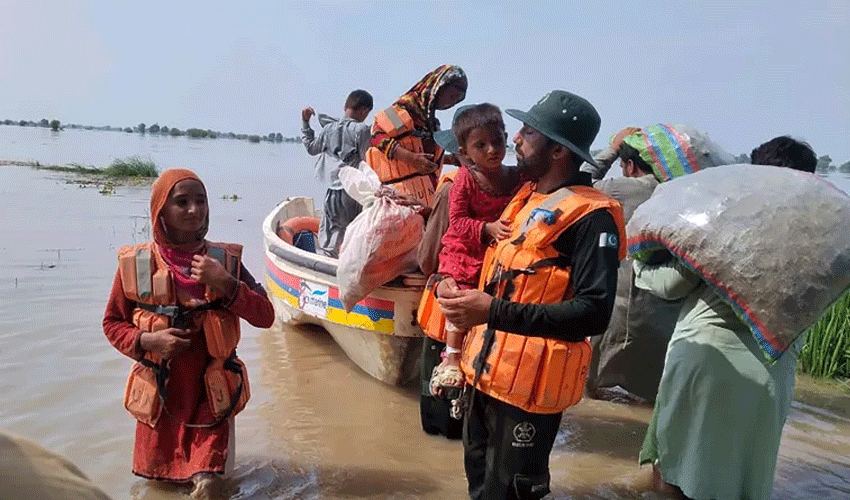
Both the impacts are visible and invisible. Wells go dry. The land dries because spaces below sink. Crops wither posing risk to food security. More pumping costs more to farmers, as they have to drill deeper. And when the water dries up on land, it evaporates, descends into the seas and drives swelling oceans that will take its toll on advancing cities.
Today, according to scientists, the world will run out of water if it loses its groundwater savings accounts.
- A Future on the Edge
- The results are already manifesting themselves:
- Farmers unable to produce food.
- Increasing the amount of traffic out of drought stricken areas.
- Increasing water falls.
- Government destabilization not ready to be scarce.
A report published by Arizona State University involving J. Famiglietti, a hydrologist, referred to them as, perhaps, the most terrifying message so far regarding the effects of climate change on water. He foreshadows massive drought and desertification in the future.
Experts opine that it is not merely a crisis of nature, but rather of choices. Anyone can in most places drill an infinity of wells without any limits, without meters, and without paying what they pump. This unfettered consumption is no better than stealing the future generation in the present.
The researchers emphasize that even though halting climate change is a worldwide predicament, groundwater management is one measure that can be taken presently by humans. They claim that ground water will emerge as the most precious natural resource in the 21st century.
In the End
Everything in life touches water, study Co.author Hrishikesh Chandanpurkar said.
When these water trust funds run dry water bankruptcy is just around the corner.