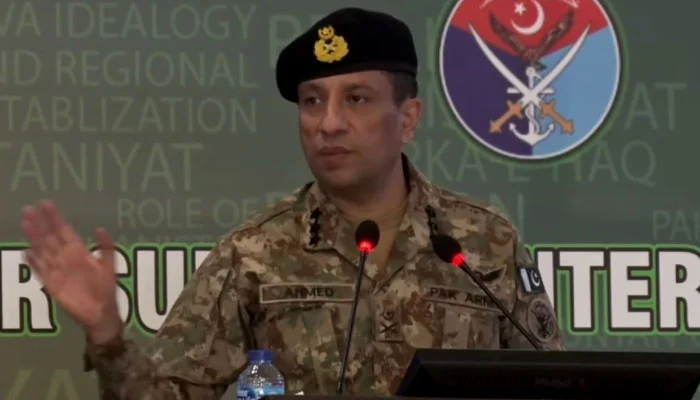
RAWALPINDI: Director General Inter-Services Public Relations (DG ISPR) Lieutenant General Ahmed Sharif Chaudhry on Saturday reiterated that innocent communities must never be subjected to collective punishment for the crimes of individual terrorists.
Speaking to a group of students from Balochistan during a special interactive session, the DG ISPR emphasised that counter-terrorism operations are always intelligence-based (IBOs), designed to eliminate threats without harming civilians.
“The actions of one terrorist should not endanger entire communities. Our operations focus on precision and cooperation with locals,” Lt Gen Chaudhry said.
Major Kakar Remembered as National Hero
The military spokesperson paid tribute to Major Muhammad Anwar Kakar, hailing him as a heroic son of the soil who had neutralised multiple terrorists during the Gwadar attack. He underlined that sacrifices made by officers, soldiers, and civilians continue to safeguard the nation daily.
Warning for Terrorist Facilitators
Lt Gen Chaudhry issued a clear warning that individuals who provide shelter to terrorists or store explosives will face accountability. However, he stressed that the wider community must not be punished for the actions of a few.
He praised the resilience of the Baloch people, noting that locals are actively reporting terrorist activity in their areas, playing a crucial role in counter-terrorism efforts.
Unity Beyond Ethnic Divides
Highlighting Pakistan’s founding principles, the DG ISPR said the essence of the country lies in the Kalma rather than ethnic or regional identities.
He noted that Balochistan is home not only to Baloch but also to Pashtun communities — with over 30% of its population being Pashtun — and that more Baloch reside outside the province than within it.
Citing examples of prominent Baloch citizens including Cambridge-educated scientist Samad Yar Jang, martial arts champion Shahzaib Rind, and women serving as deputy commissioners, the ISPR chief stressed that educated youth in Balochistan are shaping their own destinies.
He concluded that “La ilaha illallah” is the unifying spirit of Pakistan, transcending all regional and linguistic differences.