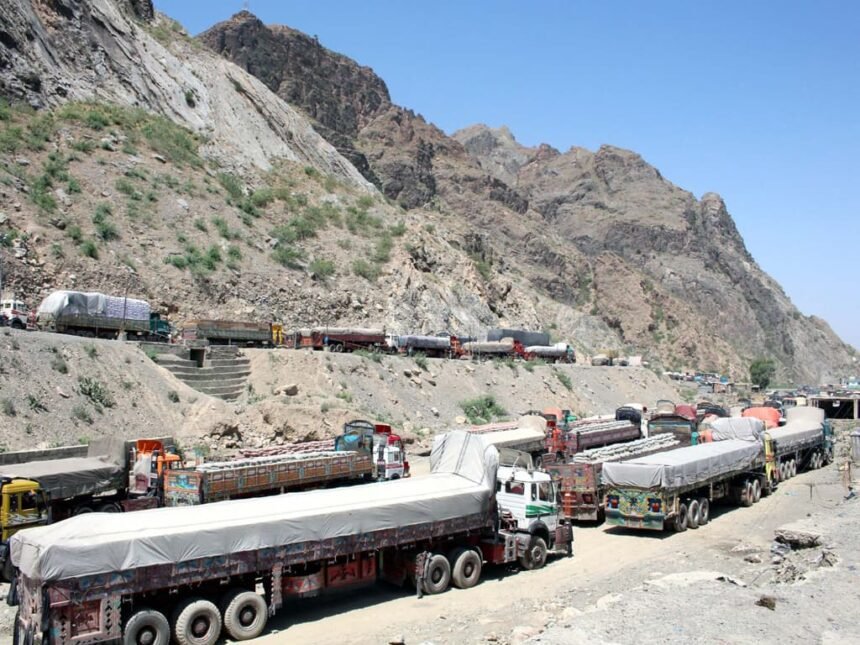
The Federal Board of Revenue (FBR) has suspended all Afghan Transit Trade operations through Karachi’s ports following mounting unrest at the Pak-Afghan border, triggering massive disruptions in cross-border trade and heavy financial losses for traders on both sides.
According to official orders issued by the FBR, all gate passes for Afghan Transit consignments have been canceled, and cargo clearance at both Karachi Port and Port Qasim has been halted with immediate effect. The suspension comes as part of an emergency directive to address growing congestion at the terminals caused by the recent closure of the Pak-Afghan border.
Officials confirmed that the decision was made during a high-level meeting at the Custom House, Karachi, chaired by the Director General of Customs. The move aims to prevent further logistical chaos and implement new, technology driven protocols to streamline future trade operations.
Under Office Order 98 of 2025, the suspension will continue until trade activities resume at border customs stations with Afghanistan. The FBR also announced fresh measures requiring the installation of advanced tracking systems including Prime-over Devices (PMDs) and Container Surveillance Devices (CSDs) on all bonded vehicles before port entry. These steps are designed to ensure proper coordination between tracking companies and terminal operators, eliminating unnecessary vehicle congestion at the ports.
Trade representatives have warned of severe economic consequences. Junaid Makda, President of the Pak-Afghan Joint Chamber of Commerce, revealed that more than 1,300 containers are now stranded 291 at Karachi ports, 500 at Chaman, 400 at Torkham, and 200 at Ghulam Khan and Kharlachi combined. Hundreds more remain aboard ships waiting to be offloaded.
Makda noted that the suspension has caused daily losses exceeding one billion rupees, with perishable goods such as food, confectionery, and chocolates being sold at half their original prices to minimize damage. “All warehouses at Torkham are already full, and traders are under immense pressure,” he added.
Customs officials in Quetta and Peshawar have confirmed that their facilities have reached full capacity and can no longer accommodate incoming shipments.
The FBR’s latest directives mark an unprecedented intervention to manage Pakistan’s worsening border and port crisis, as authorities struggle to balance trade facilitation with national security concerns.