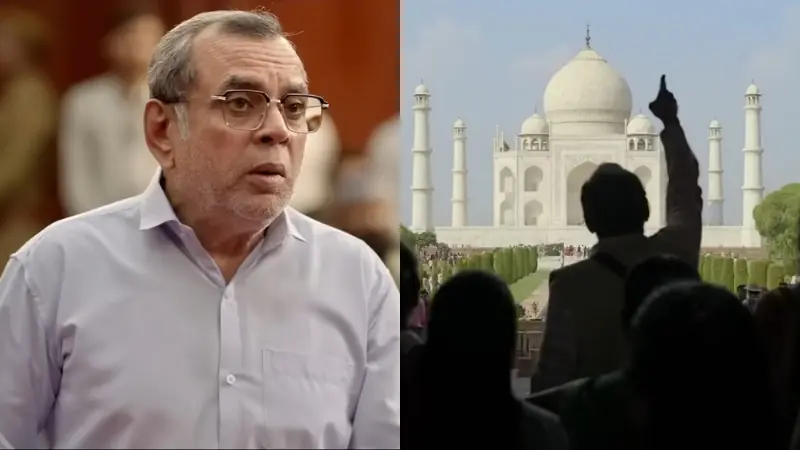
Bollywood veteran Paresh Rawal has found himself at the center of a storm after the release of the motion poster for his upcoming film, The Taj Story. The teaser — which depicts Rawal removing the dome of the Taj Mahal to reveal a statue of Lord Shiva hidden beneath — has ignited fierce debate across India.
The tagline in the poster reads:
“What if everything you’ve been taught is a lie? Unveil the facts with The Taj Story.”
The statement, combined with the imagery, quickly led viewers to believe the film is pushing the long-debunked claim that the Taj Mahal was originally a Hindu temple — a theory rejected by historians and the Archaeological Survey of India (ASI).
Social Media Backlash
Within hours of the poster’s release, social media platforms were flooded with criticism. Users accused the film of promoting historical revisionism and communal propaganda under the guise of “untold truth.”
Many called out Paresh Rawal directly, expressing disappointment that an actor of his stature would lend credibility to such claims.
“This is not storytelling, it’s distortion,” wrote one user on X.
Another said, “It’s shameful to weaponize art to rewrite history.”
Meanwhile, supporters of the film praised it for “daring to question mainstream narratives,” calling it a necessary step toward “correcting historical wrongs.”
What the Filmmakers Say
Amid the growing outrage, the film’s makers issued a clarification, saying The Taj Story “does not deal with religion” and is instead “a cinematic exploration of forgotten facts and perspectives.”
Paresh Rawal himself defended the film, telling reporters:
“We’re not attacking history — we’re exploring it. Let the audience watch and decide before jumping to conclusions.”
The actor also hinted that the film would reveal “a chapter from India’s past that many are uncomfortable acknowledging.”
CBFC Scrutiny
Sources suggest that the Central Board of Film Certification (CBFC) has already sought detailed documentation from the filmmakers, asking for historical evidence to support any claims made in the movie before granting certification.
Censors are reportedly wary of the film’s potential to inflame communal sentiments, particularly given the sensitivity around Mughal-era monuments and the Taj Mahal’s global cultural significance.
Historians Push Back
Academics and historians, however, have dismissed the movie’s premise as baseless.
They note that similar claims — like those popularized by the late writer P. N. Oak — were rejected by courts for lack of evidence. The ASI has repeatedly affirmed that the Taj Mahal was commissioned by Emperor Shah Jahan in memory of his wife Mumtaz Mahal, and not built over a temple.
“It’s unfortunate that cinema is being used to spread pseudo-history,” said one Delhi University historian. “The Taj Mahal is a symbol of art, architecture, and love — not atrocity or genocide.”
A Larger Debate
The Taj Story comes at a time when conversations around history, faith, and national identity are deeply polarized in India.
For some, it represents artistic freedom and the right to question; for others, it’s another attempt to rewrite history through fiction and ideology.
Either way, the controversy has already done what most filmmakers dream of — made The Taj Story one of the most talked-about movies before it’s even released.