It’s not often that Palestinian cinema gets this kind of spotlight on the global stage — but this year, three powerful films, each set in a different era of Palestinian life, are vying for recognition at the 98th Academy Awards.
Together, they trace nearly a century of struggle, identity, and survival — from colonial-era Jerusalem to present-day Gaza.
1. “Palestine 36” — A Past That Feels Uncomfortably Present
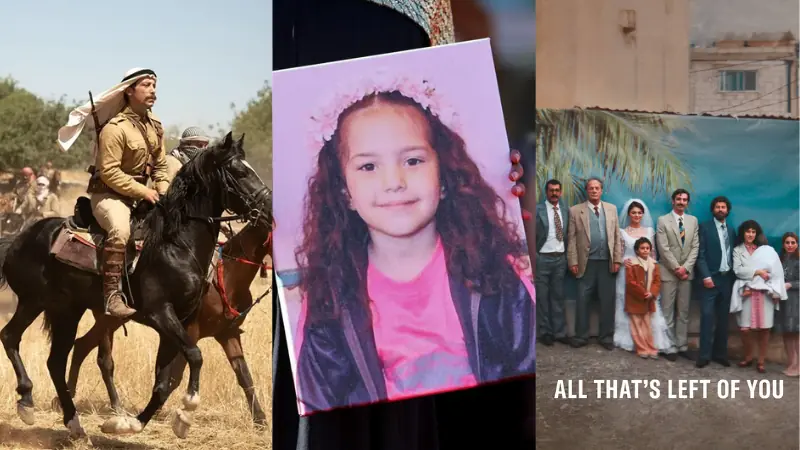
Annemarie Jacir’s Palestine 36 takes us back to Jerusalem in 1936, during the Arab revolt against British colonial rule. But while the setting is historical, the emotions — fear, resistance, and resilience — feel painfully current.
The film follows ordinary people caught in the chaos of a city on edge. No grand speeches, no polished heroes — just everyday lives unraveling under occupation.
Critics at the Toronto Film Festival called it “a haunting echo of today’s Palestine,” and honestly, it’s hard to disagree. Jacir, who’s long been a cornerstone of Palestinian cinema, doesn’t just reconstruct the past; she draws a mirror between generations.
Palestine 36 is Palestine’s official submission for Best International Feature Film — and if it lands a nomination, it would be a first for Jacir and a proud moment for a nation whose stories are too often muted.
2. “All That’s Left of You” — Memory as a Form of Resistance
Cherien Dabis, the Palestinian-American filmmaker known for Amreeka and The United States of Tara, takes a deeply personal route with All That’s Left of You.
The story unfolds across three generations of a Palestinian family scattered between Amman, Haifa, and the diaspora. It’s less about war and more about what comes after — the quiet grief, the inherited trauma, the fading of language and land.
Jordan selected it as its Oscar contender, and the film’s already created a buzz with executive producers like Javier Bardem and Mark Ruffalo championing it.
What’s striking is how Dabis turns loss into something tangible — a photograph, a lullaby, a recipe — each piece holding what’s left of a homeland. As one critic put it, “This isn’t just a film about Palestine; it’s about how memory fights extinction.”
3. “The Voice of Hind Rajab” — Gaza’s Pain in Real Time
And then there’s The Voice of Hind Rajab — the most gut-wrenching of the three.
Directed by Tunisia’s Kaouther Ben Hania, it tells the true story of six-year-old Hind Rajab, who was trapped in a car with her dead family during an Israeli strike in Gaza earlier this year. Her desperate phone call to emergency responders became a symbol of human horror and helplessness.
Ben Hania transforms that moment into a film that blurs the line between documentary and narrative. Tunisia has submitted it as its entry for Best International Feature, and audiences at Venice reportedly gave it a ten-minute standing ovation.
It’s not an easy watch. But it’s one of those stories that refuses to be ignored — and that’s exactly the point.
A Century of Struggle, A New Chapter of Storytelling
From Jacir’s pre-Nakba Jerusalem to Ben Hania’s modern-day Gaza, these films aren’t connected by plot or characters — but by persistence. They reflect a people who’ve lived through exile, occupation, and silencing, yet continue to tell their stories through art.
This year’s Oscar race, for once, isn’t just about cinema. It’s about visibility — and about reclaiming narrative space that’s been denied for decades.
As film critic Nadia Mansour put it, “From 1936 to 2024, Palestine is finally telling its story — not as a footnote in someone else’s history, but as a living, breathing truth.”