In a major win for Pakistan’s academic representation abroad, three Pakistani students at Oxford University secured a decisive victory over their Indian counterparts in a widely anticipated Oxford Union debate examining India’s national security policy and its populist underpinnings.
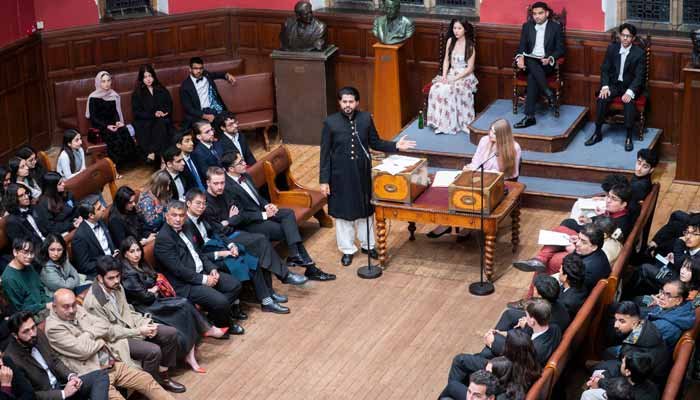
The event, held at the prestigious debating chamber on Friday, focused on the motion: “This House Believes India’s Policy Towards Pakistan is a Populist Strategy Sold as Security Policy.”
The Pakistani side Moosa Harraj, Israr Khan Kakar, and Ahmed Nawaz Khan representing the proposition, won by a sweeping margin of 160 votes to 51.
India Withdraws Original Line-Up
The debate drew heightened scrutiny after India pulled its initial high-profile speakers. Former army chief Gen (retd) M.M. Naravane, former law minister Dr Subramanian Swamy, and former Rajasthan deputy chief minister Sachin Pilot were originally set to speak.
Pakistan had planned to field former Minister of State for Foreign Affairs Hina Rabbani Khar, former Chairman Joint Chiefs Gen (retd) Zubair Mahmood Hayat, and Pakistan’s High Commissioner to the UK Dr Mohammad Faisal.
Instead, India sent a replacement panel of J. Sai Deepak, Pandit Satish Sharma, and Deorchan Banerjee a move that sparked debate-day controversy and speculation that the event might be cancelled. The Oxford Union, however, confirmed it would continue with the revised line-up.
Pakistan’s Case: India’s Policy Driven by Populism
Opening for the proposition, Moosa Harraj argued that India’s approach toward Pakistan has increasingly become an electoral tool designed to stoke nationalism rather than a genuine security doctrine.
He highlighted India’s use of hydro-politics and water management as political leverage, calling it part of a broader pattern of populist posturing.
Israr Khan Kakar expanded on this theme, tying India’s Pakistan policy to its domestic political climate. He said rising exclusionary politics especially targeting Muslims reflects an ideological shift that shapes India’s foreign policy.
Referring to the escalation following the Pahalgam incident, he warned how quickly tensions can spiral when driven by political incentives rather than strategic necessities.
Kakar also accused India of backing militant proxies, referencing alleged involvement in Balochistan and links to the TTP. He stressed that Pakistan, despite being one of the biggest victims of terrorism, continues to operate as a responsible nuclear state.
Concluding the argument, Ahmed Nawaz Khan underscored Pakistan’s resilience, describing how the country has significantly strengthened its security and diplomatic posture.
He argued that narratives portraying Pakistan as a destabilising actor are outdated, noting improvements in governance, counterterrorism, and regional engagement.
Debate Draws Strong Audience Interest Despite Upheaval
The withdrawal of Indian speakers prompted the Pakistan High Commission in London to prematurely declare victory on social media, raising further attention.
Even so, the event went ahead with a packed chamber of students, diplomats, and observers keen to hear a structured discussion on Indo-Pakistan relations.
In the end, the overwhelming vote margin reflected strong student support for the proposition’s central argument: that India’s Pakistan policy serves domestic populist politics more than regional security needs.