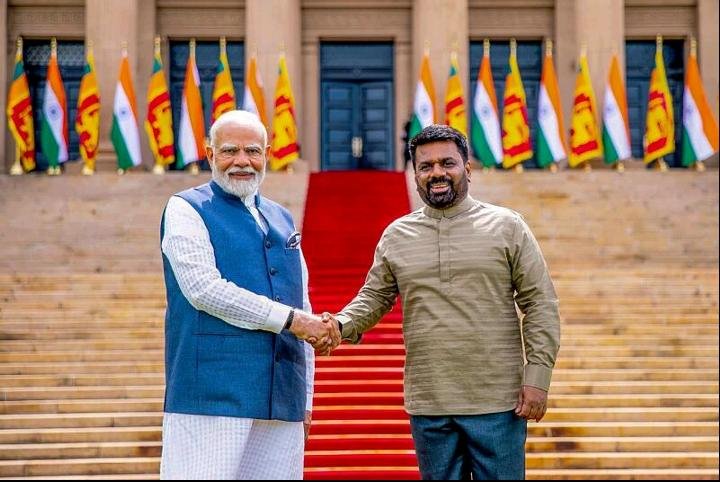
COLOMBO, April 5, 2025 — Indian officials used Prime Minister Narendra Modi’s meeting with Sri Lankan President Anura Kumara Dissanayake to push a bigger regional energy vision centered on Trincomalee, turning a long-discussed strategic port city on Sri Lanka’s eastern coast into a multi-country energy hub rather than just another bilateral project. The clearest outcome was a trilateral memorandum involving India, Sri Lanka and the United Arab Emirates to develop Trincomalee for energy purposes, alongside a broader package of India-backed power and infrastructure agreements.
The message from New Delhi was pretty direct. In the joint press appearance, Modi said the two sides had reached an agreement to build a multi-product pipeline and develop Trincomalee as an energy hub, adding that the arrangement would benefit Sri Lankans and that a separate grid interconnection deal could eventually create openings for Sri Lanka to export electricity. He also linked the plan to the 120-megawatt Sampur solar project, which both sides presented as part of Sri Lanka’s push for stronger energy security.
That matters because this was not a one-off ceremonial line tucked inside a summit statement. Sri Lanka’s President’s Office said seven memoranda of understanding were exchanged in the presence of Dissanayake and Modi, covering sectors including energy, defense, health and digitalization. In other words, Trincomalee was placed inside a much larger reset in India–Sri Lanka ties — one that mixes economics, infrastructure and security in the same frame.
The trilateral piece is what really gives the story weight. According to the UAE’s state news agency, the agreement was signed by the UAE Ministry of Investment, India’s Ministry of Petroleum and Natural Gas and Sri Lanka’s Ministry of Energy, with the stated aim of jointly developing Trincomalee into a strategic energy hub to bolster Sri Lanka’s energy security. That gives the project outside capital and political backing, and it suggests India wants the eastern Sri Lankan port to become part of a wider regional energy map, not merely a domestic storage or refining site.
There’s a strategic edge here that nobody in the region is likely to miss. AP reported that the defense and energy deals signed during Modi’s visit were widely seen as strengthening India’s economic and strategic influence in Sri Lanka at a time when New Delhi remains wary of China’s footprint on the island. Sri Lanka sits along one of the world’s busiest shipping routes, and Trincomalee — with its natural harbor and long-running energy significance — has been viewed for years as an asset with both commercial and geopolitical value.
That tension showed on the streets, too. AP reported protests in Colombo during Modi’s visit, with critics accusing the Sri Lankan government of giving away too much space to Indian interests. So while the official language was all about partnership, resilience and regional connectivity, the politics at home are more complicated. Sri Lankan leaders still have to sell these deals to a public that remains sensitive about sovereignty, debt, and foreign influence after the country’s 2022 economic collapse.
For India, though, the calculation seems straightforward. Since Sri Lanka’s crisis, New Delhi has tried to convert emergency assistance into longer-term influence through energy links, connectivity projects and strategic coordination. By tying together the Sampur solar plant, power-grid cooperation and the Trincomalee hub, Indian officials appear to be building an architecture in which Sri Lanka is not just a neighbor receiving aid, but a node in India’s broader Indian Ocean energy and logistics strategy. That’s the real story behind the handshake photos.