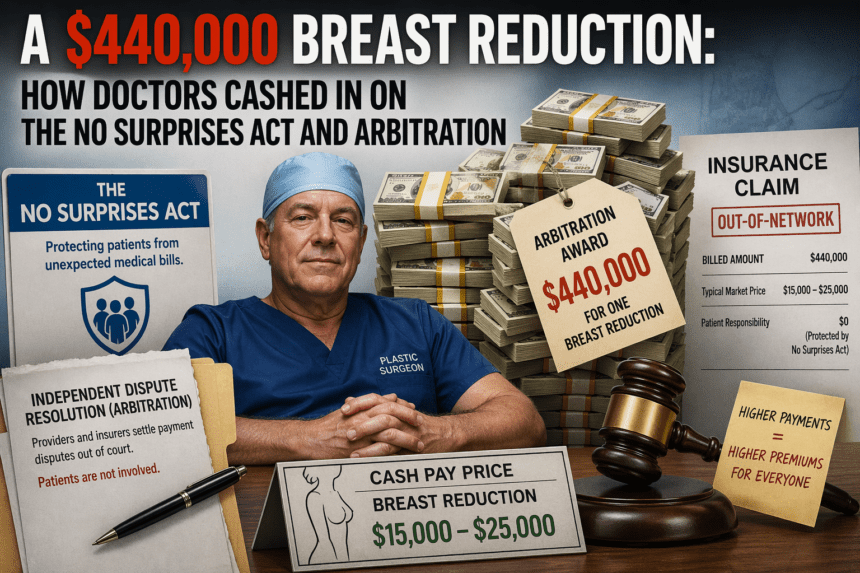
Emblem Health sued plastic surgeon Norman Rowe and related entities in federal court in New Jersey on March 27, 2026. The complaint says Rowe used the No Surprises Act’s independent dispute resolution (IDR) process to win extremely large out-of-network payments for elective breast reduction surgeries. The suit asks for damages and to vacate arbitration awards; Georgetown’s litigation tracker lists the case as ongoing.
Why the $440,000 number matters: According to the complaint, Emblem alleges Rowe obtained awards of up to $440,000 for a single routine breast reduction, even though Emblem says it had historically paid roughly $6,000 to $30,000 for those cases and had prior single-case agreements around $25,500 for the primary surgeon plus $4,080 for the assistant surgeon.
The complaint also alleges the provider represented a routine breast reduction as costing $600,000 and, in some cases, pursued separate IDR claims for primary and assistant surgeons tied to the same surgery. What the alleged playbook was: Emblem claims the surgeries were elective, pre-scheduled, and performed at in-network facilities even though the surgeons themselves were out of network, which made the disputes eligible for No Surprises Act protections and the federal IDR process. Emblem further alleges patients often already knew the surgeons were out of network and had out-of-network benefits under the NYC PPO plan, but the provider used the federal arbitration route to pursue far higher payments anyway. Why this is a bigger policy story:
The No Surprises Act, in effect since January 1, 2022, was designed to protect patients from certain surprise out-of-network bills and to keep patients out of payment fights between providers and insurers. But the law’s arbitration system has generated much heavier volume than expected. CMS says the federal IDR process exists to resolve payment disputes for certain out-of-network items and services, and recent analyses report rapidly rising dispute volume. Why insurers are alarmed: Recent 2025 data analyses say providers are winning the large majority of resolved IDR disputes. One March 2026 Health Affairs analysis found a major increase in case volume, and an American College of Radiology summary of CMS data said providers won 88% of disputes in early 2025. That does not prove Emblem’s allegations in this case, but it helps explain why this lawsuit is being treated as a test of whether some providers are exploiting the arbitration system.
The headline is really saying: a law meant to stop surprise billing may be creating a new opportunity for outsized provider payments through arbitration. In this case, though, the explosive details are still allegations in an active lawsuit, not established findings by the court. I can also give you a plain-English walkthrough of how the No Surprises Act arbitration process works in this case.