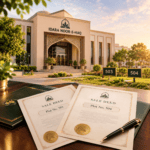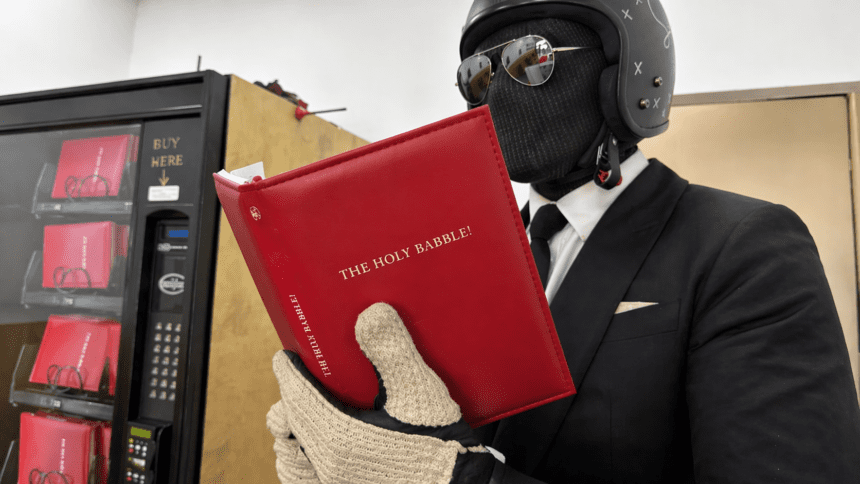
New York City — A striking new art exhibition in Manhattan is turning heads by presenting Trumpism—the political movement associated with former U.S. President Donald Trump—as a contemporary religious experience. Titled “The Holy Babble!”, the installation transforms a gallery into a space that echoes the grandeur and ritual of traditional places of worship.
Visitors entering the exhibit encounter stained glass panels, altar-like displays, and immersive visual installations that reimagine Trump’s rhetoric as sacred scripture. At the center is a 250-page book that translates Trump’s speeches and tweets into a form reminiscent of religious texts, inviting audiences to consider the movement’s cultural weight in a spiritual context.
“The goal isn’t just to comment on politics,” said the exhibit’s curator, Lydia Marsh. “We want people to see how movements like Trumpism function almost like belief systems. They offer narratives, rituals, and symbols that give followers a sense of purpose and community, much like faith does.”
The exhibition also includes multimedia presentations that mimic religious ceremonies, such as chant-like recitations of key slogans and immersive audio-visual displays that highlight the devotion of Trump’s supporters. By placing these elements in a gallery setting, the exhibit blurs the line between political allegiance and spiritual fervor, prompting visitors to reflect on the emotional and psychological dimensions of political identity.
Experts note that this framing isn’t entirely abstract. Dr. Erin Sullivan, a political sociologist at NYU, explained, “Trumpism, like any strong political movement, can exhibit traits similar to religious devotion: ritualized practices, moral storytelling, and charismatic leadership. The exhibit captures that cultural phenomenon in a very literal, almost theatrical way.”
The show has sparked mixed reactions. While some visitors find it a provocative lens on modern politics, others have criticized it as mocking sincere political beliefs. Yet, the exhibit’s combination of artistry, cultural critique, and political commentary ensures that it has become one of the most talked-about installations in New York this season.
By framing Trumpism in religious terms, “The Holy Babble!” challenges audiences to examine how ideology can shape identity, community, and meaning—raising questions about the intersections of politics, culture, and belief in contemporary society.