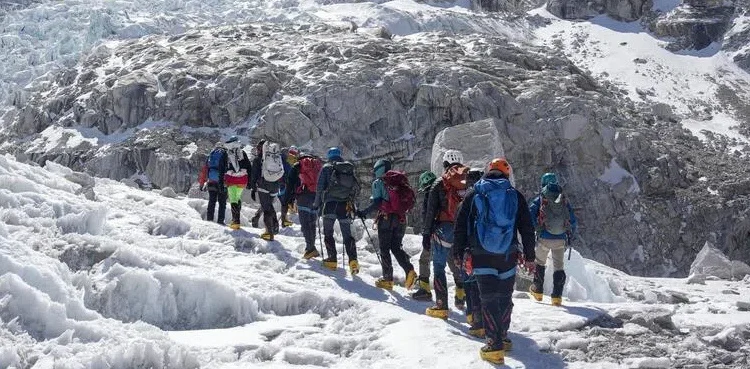
KATHMANDU, April 28 — The route through the Khumbu Icefall, the most volatile stretch on the south side of Mount Everest, has finally reopened after a dangerous serac blocked movement for roughly two weeks, allowing climbers and the specialist Sherpa teams known as Icefall Doctors to push higher up the mountain again. Local officials and expedition operators said the breakthrough on Tuesday could restart a spring season that had been drifting into uncertainty just as the main summit window approached.
The blockage had effectively frozen progress between Everest Base Camp and Camp I, forcing hundreds of climbers and Nepali guides to wait at base camp while teams assessed the avalanche risk. Nepal’s tourism authorities had already issued 410 foreign climbing permits by last week, and Kathmandu Post reported that the number had climbed to 425 by Monday, a sign that this season was shaping up to be another busy one even before the route reopened.
That’s what made the delay so tense. The Khumbu Icefall is never routine, but this time the obstacle was a large hanging block of unstable ice above the normal line, the kind of thing nobody on the mountain can simply “fix.” Himal Gautam of Nepal’s Department of Tourism had said earlier that officials could only wait, watch and assess because the threat was natural and unpredictable. The Icefall Doctors, who normally finish laying ropes and ladders by mid-April, had to hold back while the route remained exposed.
By Tuesday morning, though, the deadlock had broken. Rishi Bhandari of the Expedition Operators Association-Nepal said the route had reopened and that the Icefall Doctors were moving toward Camp II by evening. Operators also leaned on aerial reconnaissance and fresh logistics to get things moving: helicopters were used to assess conditions, while drones carried ropes and other gear toward Camp I in repeated trips. It’s a striking detail, honestly — Everest still runs on Sherpa skill and brute endurance, but more and more, technology is quietly becoming part of the story too.
The reopening matters far beyond one bottleneck. Everyone climbing Everest, Lhotse and Nuptse from the Nepali side must negotiate the Khumbu Icefall to reach the higher camps, so any delay there compresses the entire season. Expedition leaders had been worried that if the route stayed shut much longer, teams would be forced into a narrower summit window in May, increasing the odds of dangerous crowding high on the mountain. That fear isn’t abstract; congestion near the top has repeatedly become one of Everest’s defining risks in recent years.
The danger in the icefall is also backed by hard memory. In 2014, an avalanche triggered in the same area killed 16 Sherpa guides, one of the deadliest disasters in Everest’s history. That history helps explain why the caution this month was not seen as delay for delay’s sake, but as a necessary pause in a place where one bad judgment can turn fatal in seconds.
Now the waiting shifts into movement. Climbers can resume acclimatization rotations, route fixing can continue above the icefall, and expedition teams can start rebuilding a schedule that looked shaky only days ago. Still, the season remains delicate. The south side of Everest is open again, yes, but on a mountain like this, “open” never means easy — only that the next stretch of risk has begun