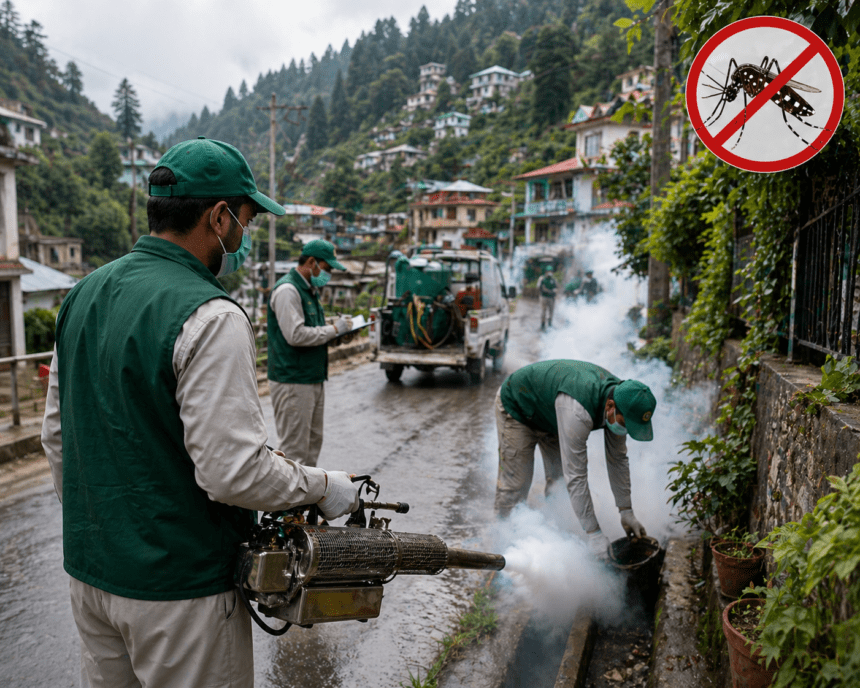
Murree’s local administration has ramped up its anti-dengue protocols, ordering a city-wide sweep after recent health reports indicated a spike in larvae detection. Deputy Commissioner Agha Zaheer Abbas Sherazi chaired an emergency session Tuesday, demanding an immediate end to the “compartmentalized” approach that has hampered containment efforts so far.
Health officials reported that high-altitude clusters—previously considered low-risk—are now showing increased mosquito activity.
The administration’s new directive mandates that all departments, from municipal sanitation to the forest department, stop working in silos. “We aren’t just looking at the city center anymore,” a senior health officer told reporters following the meeting. “The focus is shifting to construction sites and water storage points in the periphery, where negligence is currently high.
” The strategy relies on a three-pronged push: localized fogging, aggressive larvae elimination, and mandatory reporting for private clinics. Under the new rules, private practitioners must notify the district health office within 24 hours of identifying a suspected dengue case. Failure to do so will result in immediate license reviews.
Critics have pointed to the administration’s delayed reaction, noting that similar warnings were ignored during the early monsoon season. Sanitation workers remain stretched thin, and the district’s reliance on manual reporting continues to create gaps in real-time data.
The administration has also launched a public awareness campaign, though the effectiveness remains tied to how strictly the district enforces its own fines. With temperatures fluctuating, the window to curb the vector population is closing fast.
“If the coordination holds, we might avoid a crisis,” said one local health administrator. “But the next ten days are critical.”