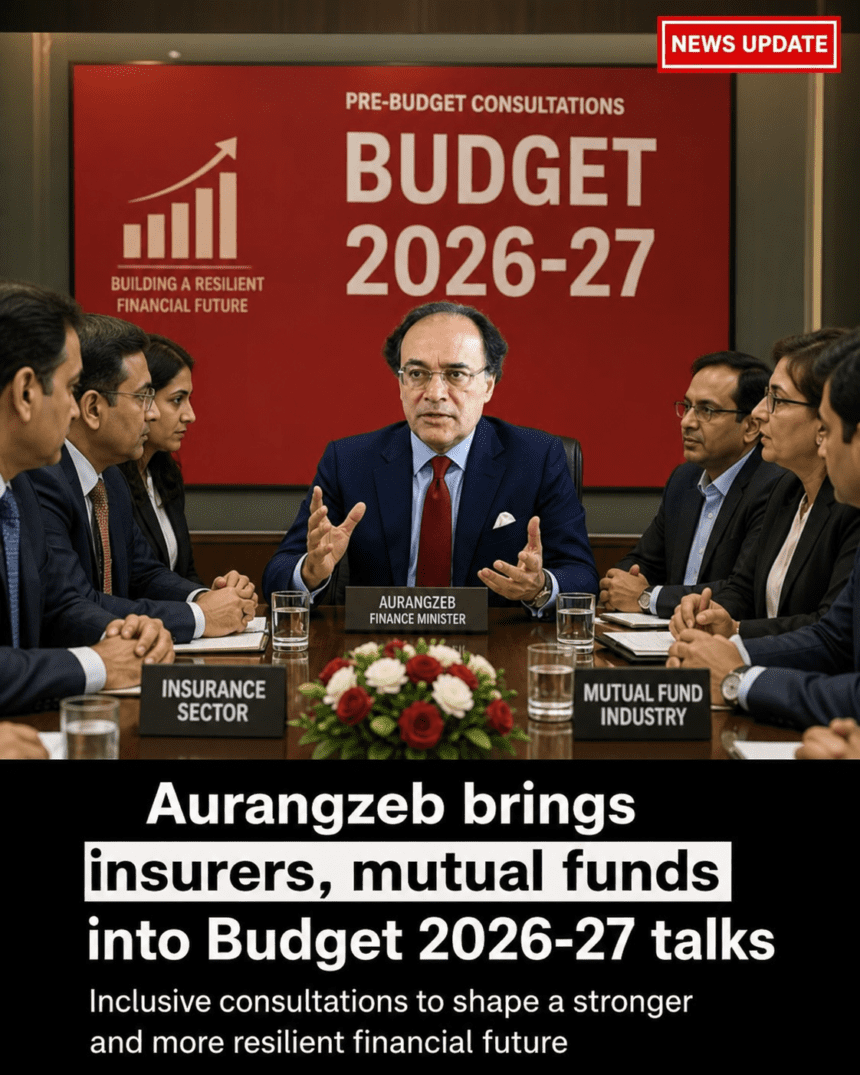
ISLAMABAD, May 5 — Finance Minister Muhammad Aurangzeb on Tuesday widened the government’s pre-budget outreach, meeting delegations from Pakistan’s insurance and mutual fund industries as the Finance Ministry gathers proposals ahead of the FY2026-27 federal budget. The back-to-back consultations, held at the Finance Division, focused on something the government clearly wants to push harder this year: savings, long-term investment, and a deeper domestic financial market.
The first meeting was with the Mutual Funds Association of Pakistan, led by MUFAP chairman Shahzad Dada. According to the Finance Ministry, the discussion covered the mutual fund industry’s role in savings mobilization, financial intermediation and capital-market development, along with industry views on the budget framework and regulatory changes needed to support growth. Officials and industry representatives also discussed alternative fund vehicles, stronger retail participation, and greater involvement by non-bank financial institutions.
One point stands out. Participants also raised the issue of National Savings Schemes, arguing that those instruments should be aligned more closely with broader market dynamics so they do not distort competition across savings products. The ministry’s wording was careful, but the message was fairly clear: fund managers want a more level playing field as they compete for household savings.
Later, Aurangzeb met the Insurance Association of Pakistan, led by IAP chairman Shoaib Javed Hussain, for a separate consultation centered on Budget 2026-27. That discussion leaned more heavily toward taxation and regulation. The industry presented proposals dealing with the interaction between federal and provincial levies, the need for a more predictable tax structure, and clearer application of sector-specific insurance laws within the wider tax framework.
The insurance side also pushed a broader policy case, not just a tax one. According to the Finance Ministry, the delegation proposed measures to expand insurance penetration and promote savings, including the possible restoration of tax incentives for policyholders. It also flagged long-term savings products and wider participation by salaried individuals as areas needing attention. In plain terms, the industry is asking the government to make formal insurance and savings products more attractive at a time when disposable incomes remain under pressure and financial protection is still thin for a large part of the population.
Aurangzeb, for his part, did what finance ministers usually do in these meetings: he listened, thanked the delegations, and said the proposals would be reviewed as part of the budget-making process. Still, the ministry’s readout gives a decent sense of direction. In both meetings, he stressed sustained dialogue with key sectors, the need for a balanced policy environment, and the government’s aim of supporting financial-sector development without losing sight of overall fiscal stability.
These consultations did not happen in isolation. They follow a broader round of pre-budget engagement that began at least publicly in early April, when Aurangzeb held a nationwide virtual session with chambers of commerce and business groups to discuss the economic situation, budget priorities and ideas for recovery and growth. In that earlier meeting, the emphasis was on predictability, competitiveness, liquidity, investment and the business climate more broadly. That makes Tuesday’s talks with insurers and fund managers look like part of a larger effort to collect sector-by-sector input before the budget is finalized.
There’s a bigger policy thread running through all this. Pakistan’s Finance Ministry appears to be trying to widen the conversation beyond the usual annual fight over tax rates and exemptions. The official language around Tuesday’s meetings repeatedly referred to “savings mobilization,” “financial inclusion,” “capital market development,” and “long-term instruments.” That matters because Pakistan’s budget challenge is not only about raising revenue; it is also about channeling domestic savings into formal instruments that can support investment and reduce pressure on the state’s own financing architecture. That is an inference from the ministry’s framing and the issues raised by both sectors, rather than a declared budget decision.
What the ministry did not disclose is just as telling. The official statements gave no timelines for decisions, no draft tax measures, and no estimate of the fiscal impact of any proposal under discussion. So, for now, these remain consultations, not commitments. But politically and economically, they signal where attention is drifting: toward household savings, insurance penetration, retail investing, and a more active role for private financial institutions in the government’s growth story.