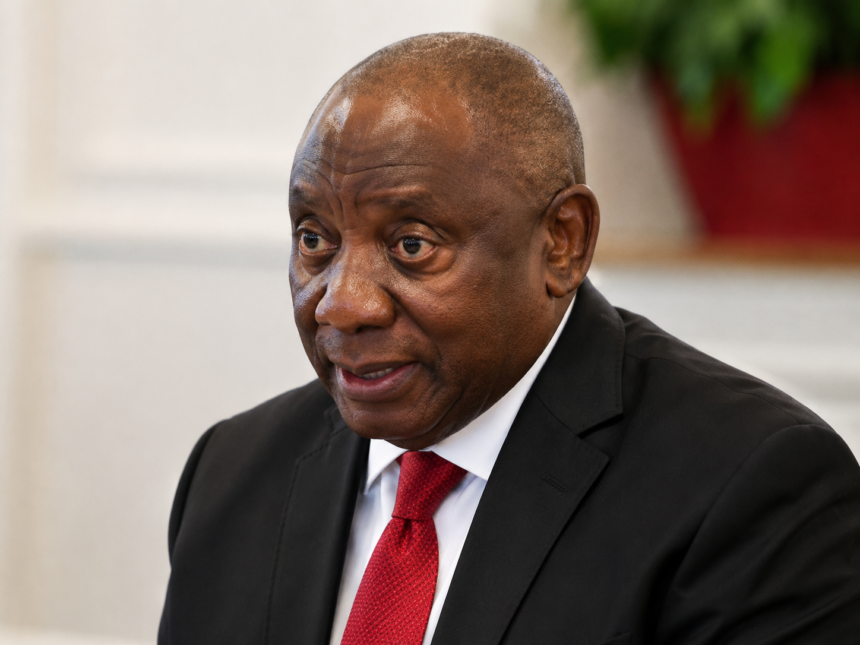
President Cyril Ramaphosa is under fresh pressure after South Africa’s Constitutional Court ruled on Friday, May 8, 2026, that Parliament acted unconstitutionally when it blocked the next stage of impeachment proceedings tied to the long-running Phala Phala cash scandal. The judgment does not remove Ramaphosa from office, but it does reopen a politically dangerous process that many in his governing circle had hoped was over.
In plain terms, the court found that the National Assembly should not have been able to kill the process at such an early point. The majority judgment said Parliament’s Rule 129I was constitutionally defective because it allowed lawmakers to stop an impeachment track before a full investigation had been carried out. The court set aside both that rule and the National Assembly’s 2022 vote, and ordered that the Section 89 panel report now be referred to an impeachment committee.
That ruling has instantly changed the political temperature in Pretoria. Julius Malema, leader of the Economic Freedom Fighters, said Ramaphosa should resign and focus on the impeachment process, while other opposition voices framed the decision as proof that Parliament had shielded the president when the African National Congress still had the numbers to do so. Ramaphosa, for his part, has maintained that he did nothing wrong and has said he will continue to cooperate with legal and parliamentary processes.
The case goes back to the Phala Phala affair, one of the most stubborn scandals of Ramaphosa’s presidency. At the center of it is the theft of about $580,000 in cash from a sofa at his private game farm. A parliamentary independent panel, chaired by former chief justice Sandile Ngcobo, concluded in 2022 that there was prima facie evidence suggesting Ramaphosa may have committed serious violations of the Constitution or the law, or engaged in serious misconduct. Parliament then voted against sending the matter on for a deeper inquiry. Friday’s judgment effectively reverses that political shield.
Ramaphosa has long argued that the money came from the sale of buffalo and has denied any criminal conduct. He has also survived several other official processes around the same saga. But this ruling matters because it revives the one route that always carried the biggest political risk: a formal impeachment mechanism inside Parliament itself. And this time, the arithmetic is not what it was in 2022. The ANC no longer holds the outright parliamentary majority it once used to protect him.
The court’s own media summary makes clear how serious the decision is. It says the earlier parliamentary vote was invalid and that the report must go to the impeachment committee, where evidence can be tested more fully before lawmakers decide what comes next. There were split views among the judges on some constitutional reasoning, but the practical outcome is unmistakable: the matter is back in play, and Ramaphosa’s opponents now have a live institutional process to work with, not just a slogan.
For Ramaphosa, the immediate danger may be less legal than political. He is serving his final term, but a reopened impeachment process could drain authority from the presidency, deepen factional fights inside the ANC, and add stress to South Africa’s already delicate coalition-era politics. Friday’s ruling doesn’t end his presidency. It does, though, reopen the question that had been buried for more than three years: whether the Phala Phala scandal still has the power to break it.