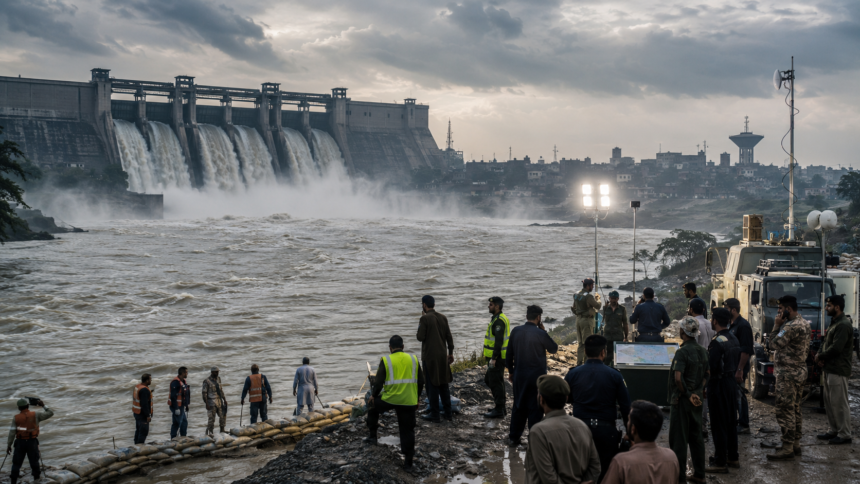
Sialkot: Authorities in Sialkot have been placed on high alert after India opened the spillway gates of Salal Dam on the Chenab River for reservoir silt flushing, raising concerns over a sudden rise in water levels near Head Marala and nearby riverbank settlements.
According to official alerts, the spillway gates of Salal Dam in Reasi district of Indian-administered Jammu and Kashmir were scheduled to remain open from May 21 to May 30, 2026, starting at 9:00am, for desilting work. The move prompted Punjab’s disaster management authorities to warn that the Chenab’s water level could rise abruptly by two to three metres, particularly at Marala Barrage, a key monitoring point as the river enters Pakistan near Sialkot.
The district administration has activated the District Emergency Control Room, with citizens advised to contact 052-9250011 for information and guidance. Officials have also directed all relevant departments to monitor the Chenab River around the clock, while restrictions have been imposed on the movement of people and livestock along the riverbanks and riverbed.
The concern is not only about the water volume. Officials say silt flushing can create sudden fluctuations in river flow, especially when sediment-heavy water moves downstream. That is why irrigation teams have been asked to keep a close watch on water levels, regulate canal withdrawals where needed and ensure safe operations at barrages during the release period.
Emergency services in Sialkot and other vulnerable districts have been told to remain on standby. Downstream areas, including parts of Faisalabad, Jhang, Toba Tek Singh and Chiniot, could also face pressure if the flow rises sharply in the coming days. Rescue teams have been asked to stay prepared for possible evacuations, though officials have not announced any large-scale displacement so far.
Head Marala remains the main point of attention. Located near Sialkot, it receives Chenab flows entering Pakistan and plays a major role in distributing water through linked canals. Any sudden rise there is closely watched because it can affect not only nearby villages but also downstream districts across central Punjab.
The Chenab is one of the major transboundary rivers shared by Pakistan and India, making dam operations upstream a sensitive issue. Even when releases are carried out for technical reasons such as silt flushing, downstream authorities often issue precautionary alerts because communities along the river can face quick changes in water levels.
For now, officials are urging people living near the river to avoid unnecessary movement close to the banks, keep livestock away from low-lying areas and follow instructions from local administration and rescue teams.
The next few days will be crucial. If the river remains within safe limits, the alert may pass without major damage. But authorities say they are not taking chances — because on the Chenab, even a short delay in warning can turn dangerous.