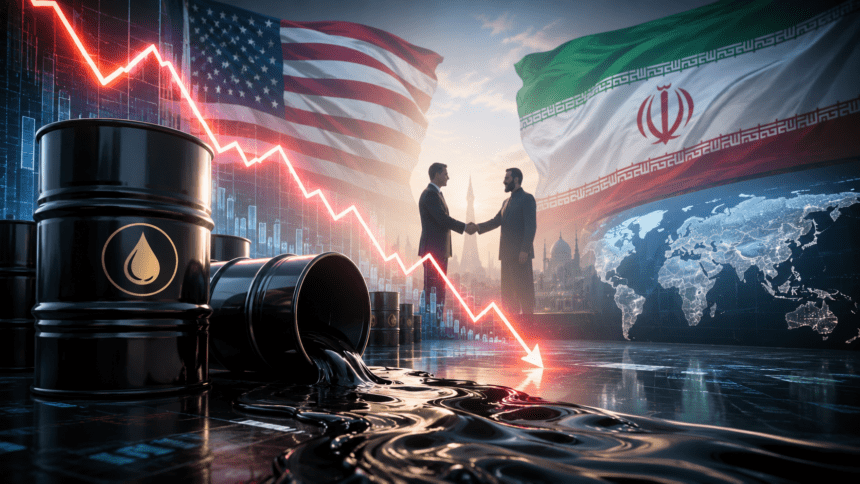
London/Singapore: Oil prices fell sharply on Monday as traders grew more hopeful that the United States and Iran could move closer to a peace deal, raising expectations that the Strait of Hormuz may gradually reopen and ease pressure on global energy supplies.
Brent crude dropped nearly 6% to around $97.50 a barrel, its lowest level in about two weeks, while US West Texas Intermediate fell to nearly $91 a barrel. Both benchmarks touched their weakest levels since May 7, reflecting a rapid shift in market sentiment after days of volatile trading.
The decline came after reports suggested Washington and Tehran were making progress on a possible arrangement that could extend a ceasefire, reopen the Strait of Hormuz and allow broader talks on Iran’s nuclear programme. The waterway has been at the centre of energy-market anxiety because it is one of the world’s most important routes for oil and gas shipments.
For markets, even a partial reopening of the strait would matter. The conflict had restricted flows, lifted freight risks and kept a war premium in crude prices. If shipping lanes become safer, traders expect some of that risk premium to fade, which is exactly what appeared to happen in Monday’s session.
Still, analysts warned that the fall in prices does not mean the crisis is over. Major disagreements remain, and any deal would need clear terms on shipping access, sanctions relief, Iranian oil exports and nuclear commitments. Full restoration of energy flows may also take time because of damage to regional infrastructure and continued security concerns.
The price move was also reflected in wider financial markets. Global stocks gained as investors welcomed the possibility of reduced geopolitical risk, while energy-linked inflation fears eased slightly. Lower oil prices can help consumers and businesses, but only if the decline lasts long enough to feed through to fuel and transport costs.
Oil has been highly sensitive to every diplomatic signal in recent weeks. Prices rose when talks appeared to stall and fell whenever officials suggested progress. That volatility is likely to continue until a formal agreement is announced and implemented.
For now, the message from the market is clear: traders are pricing in hope, not certainty. A US-Iran peace deal could bring major relief to oil markets, but one failed round of talks could quickly push prices higher again.