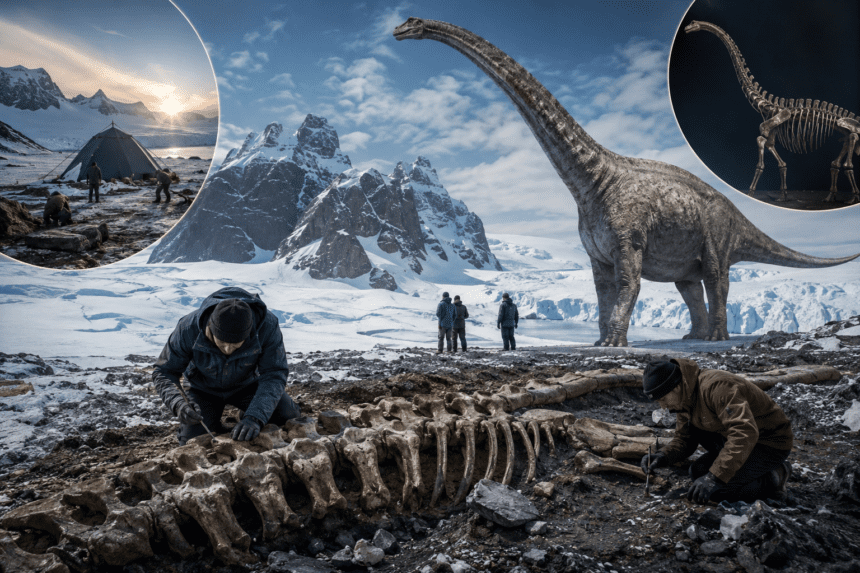
A fossilized limb bone unearthed in Antarctica four decades ago has finally been identified as belonging to a titanosaur, a discovery that fundamentally shifts our understanding of how these massive herbivores navigated the globe.
Paleontologists originally recovered the partial femur from Vega Island in 1983. For years, the specimen sat in storage, its identity obscured by the harsh conditions of its preservation and the limited comparative data available at the time. It wasn’t until a modern re-examination of the bone’s unique structural markers—specifically the way the bone grew and its distinct internal architecture—that researchers confirmed it belonged to the titanosaur family.
This wasn’t just another dinosaur bone. Finding a titanosaur in Antarctica confirms these giants were far more geographically widespread than previous records suggested. During the Late Cretaceous period, Antarctica was significantly warmer than its current frozen state, providing a lush, forested environment capable of sustaining massive sauropods.
The titanosaur, likely a smaller member of the group, navigated the southern polar regions roughly 70 million years ago. This discovery suggests that as these animals migrated, they crossed land bridges that once connected South America to the Antarctic peninsula before the continents drifted into their current positions.
The identification process proved arduous. Researchers had to rely on fragmented physical evidence and compare it against a growing database of titanosaur remains found in Patagonia and other parts of the Southern Hemisphere. The bone’s density and the specific arrangement of its vascular channels provided the final proof, separating it from other long-necked species that lived during the same epoch.
While the fossil is incomplete, its existence offers a rare window into a lost ecosystem. The presence of a herbivore of this size implies a highly productive environment, one where vegetation was abundant enough to support creatures weighing several tons.
This finding forces a re-evaluation of how dinosaur populations distributed themselves across the prehistoric world. It serves as a reminder that the Antarctic ice sheet still holds secrets that could rewrite the history of life on Earth—provided we have the tools and the patience to look closer.