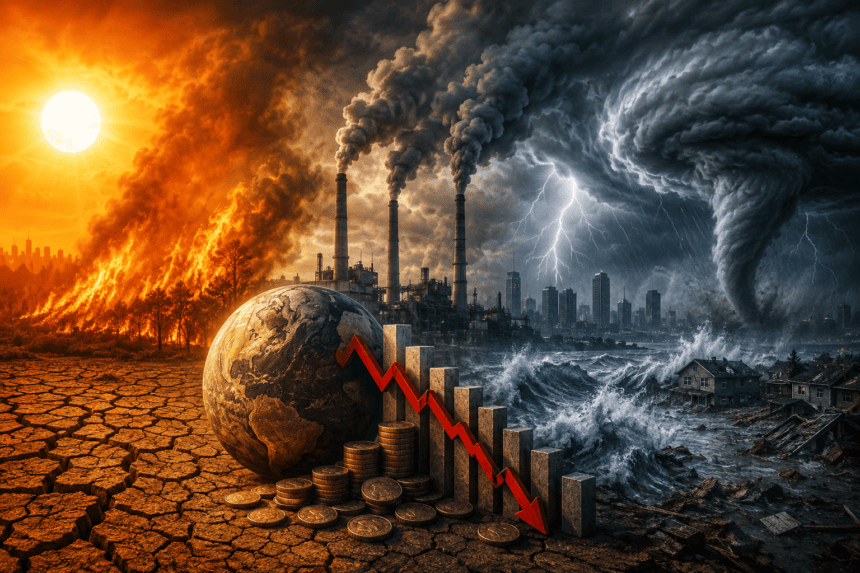
The global economy is no longer just battling inflation or supply chain snarls; it is fighting a war of attrition against a changing climate. From the scorched agricultural belts of South Asia to the fire-ravaged forests of North America, the mounting price of extreme weather is shifting from a long-term risk to an immediate, bottom-line reality for businesses and governments alike.
Insurance premiums are climbing at an aggressive clip. In disaster-prone regions, major providers are simply pulling out, leaving homeowners and businesses stranded. This isn’t a future projection; it’s happening in California and Florida, where the risk of wildfire and flood has made coverage either prohibitively expensive or entirely unavailable. When insurance vanishes, investment follows. Property values stagnate, and local tax bases begin to erode.
Agriculture remains the most vulnerable frontline. Heatwaves and erratic rainfall patterns have turned reliable crop yields into a guessing game. In Pakistan and India, record-breaking temperatures have scorched wheat crops in recent seasons, forcing governments to scramble for imports to stabilize local food prices. This volatility doesn’t just hurt the farmer; it ripples into the manufacturing sector, where raw material costs become unpredictable, forcing companies to pass the expense onto a public already struggling with the cost of living.
Disruptions to supply chains are proving equally costly. Smoke from wildfires has grounded cargo flights and delayed shipping lanes, while severe storms have repeatedly shuttered ports. These aren’t isolated incidents. They are becoming the new baseline for logistics firms that once operated on the assumption of predictable weather patterns. Every hour a ship sits idle or a truck is rerouted because of a wildfire-choked highway, the cost of goods inches upward.
Economists are now struggling to quantify the “climate tax.” While GDP figures often capture the immediate recovery costs of a disaster, they fail to account for the lost productivity, the strain on public health systems, and the capital diverted from innovation to mere survival. The focus has shifted from growth to resilience, a pivot that requires massive public spending—money that, in a high-interest-rate environment, is becoming increasingly expensive to borrow.
“We are moving past the era of ‘natural’ disasters,” says one industry analyst. “These are now systemic economic shocks. If your business model assumes the climate of 1990, you’re already behind the curve.”
As businesses and nations calculate the cost, the takeaway is clear: the economy is no longer operating in a vacuum. It is tethered to the environment, and the current volatility is the most expensive variable on the balance sheet.