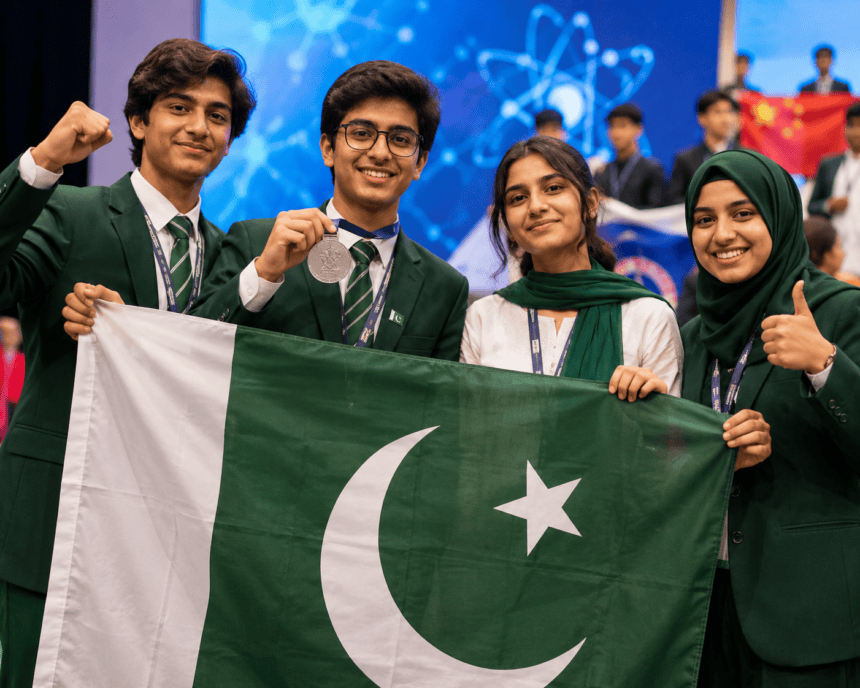
Hong Kong: Pakistan has achieved a notable success at the Asian Science Camp 2026, with Pakistani student Pariwash Hakim securing a Silver Award at the international science event held at the University of Hong Kong.
The Asian Science Camp 2026 took place from August 2 to August 8 and brought together young science students from around the world. The event provided participants with opportunities to interact with leading scientists, take part in academic activities and present research ideas in an international environment.
Pariwash Hakim was part of Pakistan’s five-member delegation selected to represent the country at the competition. Her research project progressed to the final stage of the camp’s poster competition, eventually earning the Silver Award.
The achievement came after a highly competitive process. According to reports, 54 projects were presented during the competition, with 12 projects shortlisted for the final round.
The finalists presented their research proposals before a 13-member judging panel that included Nobel laureates, university academics and industry experts. Projects were evaluated on several criteria, including the quality of the scientific idea, presentation, visualisation, time management and potential impact.
Pakistan’s participation was part of a broader international gathering involving young science students from 48 countries. More than 350 students attended the 2026 camp, creating opportunities for academic exchange, networking and collaboration.
The Pakistani delegation included five students representing different regions of the country. Their participation reflected the country’s efforts to identify and promote young scientific talent through competitive national selection.
The Pakistan Science Foundation played a key role in selecting the national delegation. Students were chosen through a competitive process designed to identify candidates with strong scientific potential.
The Silver Award is particularly significant because the competition provided students with the opportunity to present their original research ideas before an international scientific audience. Reaching the final stage itself represented a major accomplishment, given the number of projects competing for recognition.
The Asian Science Camp is designed not only as a competition but also as an academic and collaborative platform. Participants attend scientific lectures, engage in discussions and interact with experienced researchers and scientists.
For Pakistan, the award highlights the potential of young students in science, technology and research. It also demonstrates the importance of providing students with opportunities to participate in international competitions where they can test their ideas against projects from other countries.
The achievement is expected to encourage other Pakistani students to pursue scientific research and participate in international academic programs.
The success of Pariwash Hakim also provides a positive example of how young Pakistani researchers can gain international recognition when given access to competitive platforms and opportunities for scientific exchange.
The award has therefore been welcomed as an achievement for Pakistan’s youth and a reflection of the country’s emerging scientific talent on an international stage.