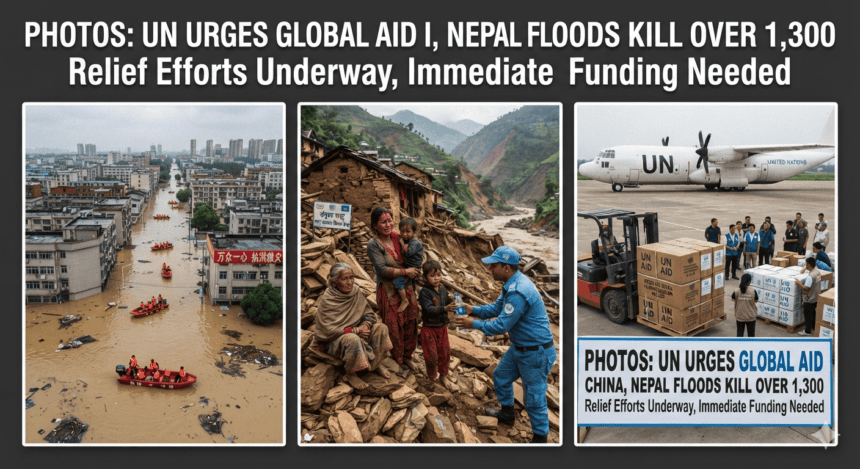
Devastating floods and landslides have claimed more than 1,300 lives across China and Nepal, forcing the United Nations to issue an urgent appeal for international humanitarian assistance. Extreme weather patterns have decimated infrastructure, leveled thousands of homes, and left entire communities cut off from emergency services.
In Nepal, the death toll has reached at least 230, with scores still missing as rescue teams struggle to navigate mud-choked mountain passes. Kathmandu’s valley was particularly hard hit, experiencing the heaviest rainfall in decades. Entire neighborhoods were submerged overnight, leaving residents to scramble onto rooftops as the Bagmati River burst its banks.
China’s situation remains equally dire. Persistent downpours triggered by seasonal shifts have caused catastrophic flooding across several provinces. State media reports confirm the total regional death toll has surged past the 1,000 mark when combined with neighboring affected areas. Agricultural land—the backbone of the rural economy—is currently underwater, threatening long-term food security for millions.
The United Nations Office for the Coordination of Humanitarian Affairs (OCHA) warned that existing local resources are exhausted. UN officials are now coordinating with regional governments to deliver clean water, medical supplies, and temporary shelter to the displaced. Logistics remain the primary challenge; landslides have rendered major highways impassable, stalling the delivery of heavy machinery required for search and rescue operations.
Local authorities in Nepal have faced intense public scrutiny regarding urban planning and the lack of flood-defense systems. Critics point to rapid, unregulated construction in flood-prone zones as a primary factor in the high casualty rates. Meanwhile, Chinese emergency management teams have deployed thousands of personnel to reinforce river embankments, though meteorologists warn that more rain is forecast for the coming week.
“We are dealing with a crisis that exceeds the capacity of any single agency,” said a UN spokesperson overseeing the disaster response. The focus remains on preventing secondary health crises—such as waterborne disease outbreaks—as stagnant floodwaters remain trapped in densely populated areas.
For those trapped in the disaster zones, the immediate future is bleak. With winter approaching in the Himalayan region, the survival of the displaced hinges on the speed of the international response. The window to reach the missing is closing, and for thousands, the recovery process has not yet even begun.