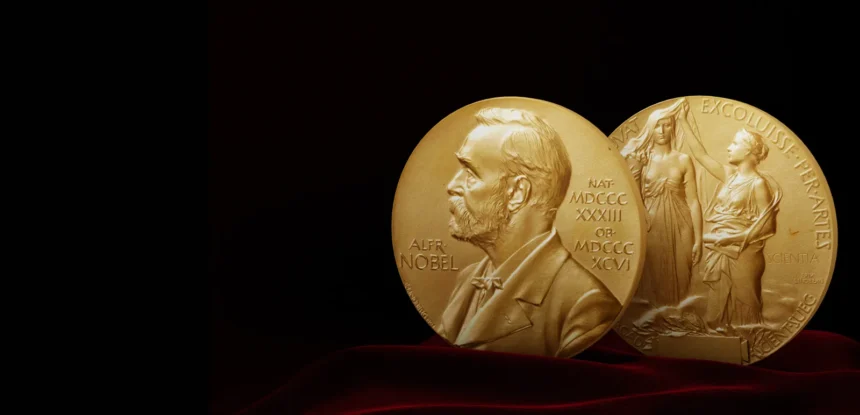
STOCKHOLM: The 2026 Nobel Prize announcements are set to begin next week, drawing global attention to achievements in science, literature and peace.
The awards recognize outstanding contributions in physiology or medicine, physics, chemistry, literature and peace. The economics prize, formally known as the Sveriges Riksbank Prize in Economic Sciences in Memory of Alfred Nobel, was established later. Each Nobel Prize carries a cash award of 12 million Swedish kronor, along with international recognition that can have a major impact on the careers of scientists, writers and other laureates.
Who was Alfred Nobel?
The prizes were created through the will of Alfred Nobel, a Swedish chemist, inventor and entrepreneur who directed that most of his fortune be used to reward people who had provided the “greatest benefit to humankind.”
Nobel is best known for inventing dynamite, but he also worked on weapons technology and built a substantial business empire. He was also a poet and linguist who spoke several languages. The five original prize categories reflected areas that interested Nobel. The peace prize is often associated with his friendship with Austrian peace activist Bertha von Suttner, who became the first woman to receive the award in 1905. Nobel died in 1896, but the first prizes were not awarded until 1901 after legal disputes over his will were resolved.
Who awards the Nobel Prizes?
The Royal Swedish Academy of Sciences awards the prizes in physics and chemistry, while the Swedish Academy selects the literature laureate.
The Nobel Assembly at Sweden’s Karolinska Institute awards the physiology or medicine prize. The Norwegian Nobel Committee, appointed by the Norwegian Parliament, selects the peace laureate.
The economics prize was established in 1968 by Sweden’s central bank, Sveriges Riksbank, to mark its 300th anniversary. It is awarded by the Royal Swedish Academy of Sciences under principles similar to those governing the original Nobel Prizes.
Some of the most famous laureates
The Nobel Prize has honored some of the world’s most influential scientists, writers and public figures, including Albert Einstein, Niels Bohr, Ernest Hemingway, Albert Camus, Nelson Mandela and Mother Teresa. The Curie family also has a notable place in Nobel history. Marie Curie won the prize twice, while her husband Pierre Curie, daughter Irène Joliot-Curie and son-in-law Frédéric Joliot-Curie were also Nobel laureates.
Only five people have received Nobel Prizes more than once. American chemist and peace activist Linus Pauling is the only person to receive two Nobel Prizes without sharing either award. The prizes have also drawn controversy over the years. The 1949 medicine prize awarded to Egas Moniz for work related to lobotomy, for example, has been questioned as scientific understanding evolved.
Several peace prizes have also faced criticism, including those awarded to Henry Kissinger, Yasser Arafat, Yitzhak Rabin and Shimon Peres. The decision not to award a Nobel Peace Prize to Mahatma Gandhi before his death in 1948 has also remained a subject of debate.
When are the Nobel Prizes presented?
The laureates traditionally receive their awards on Dec. 10, the anniversary of Nobel’s death. The Nobel Peace Prize is presented in Oslo by the chairman of the Norwegian Nobel Committee, while the other prizes are presented in Stockholm by Sweden’s king. The celebrations culminate in a formal banquet at Stockholm City Hall, attended by about 1,300 guests.
The dinner is prepared months in advance by leading Swedish chefs and sommeliers, with about 200 waiters serving the guests. The menu remains secret until the meal begins and typically features Nordic ingredients and cuisine. Last year’s menu included porcini mushroom soup, turbot stuffed with scallops and sugar kelp, followed by blackthorn berry sorbet with cheese cream and browned-butter sponge.