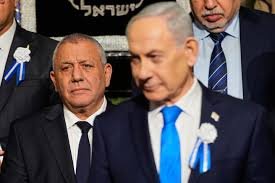
A new political dispute has emerged in Israel after caretaker Prime Minister Benjamin Netanyahu called for the formation of a national unity government with his political rival, Gadi Eisenkot. However, Eisenkot rejected the proposal, describing it as a political trick rather than a genuine effort to bring Israeli political leaders together.
Netanyahu Calls for National Unity
On November 14, 2026, Benjamin Netanyahu publicly urged Gadi Eisenkot to hold negotiations and form a broad national unity government. Netanyahu argued that Israel faces serious security challenges, particularly regarding Iran, and needs a united political leadership to protect the country’s future.
He called on political parties to put aside their differences and work together without preconditions.
Eisenkot Rejects the Proposal
Gadi Eisenkot quickly dismissed Netanyahu’s offer, accusing him of using national unity as a political strategy.
Eisenkot argued that Netanyahu was calling for negotiations even though discussions between their political parties had already been scheduled. He described the proposal as another political move designed to create confusion and influence public opinion.
Eisenkot also accused Netanyahu of encouraging political divisions while publicly speaking about unity.
Conditions for a Possible Political Partnership
Although Eisenkot has rejected forming a government under Netanyahu’s leadership, he has indicated that members of Netanyahu’s Likud party could participate in an emergency government led by him.
However, he has set certain conditions, including accepting his political principles and breaking away from extremist political groups, particularly those associated with far-right minister Itamar Ben-Gvir.
A Difficult Government Formation Process
The political situation in Israel remains complicated following the October 2026 election.
Neither political bloc secured an outright majority in the 120-member Knesset. Netanyahu’s bloc secured 53 seats, while Eisenkot’s bloc won 48 seats.
President Isaac Herzog assigned Eisenkot the responsibility of forming the next government after receiving support recommendations from 67 lawmakers.
Eisenkot now faces the challenge of bringing different political groups together to secure enough support.
Conclusion
The disagreement between Netanyahu and Eisenkot highlights the growing political divisions within Israel. While Netanyahu presents a unity government as necessary for national security, Eisenkot believes genuine unity requires political changes and a clear break with extremist partners.