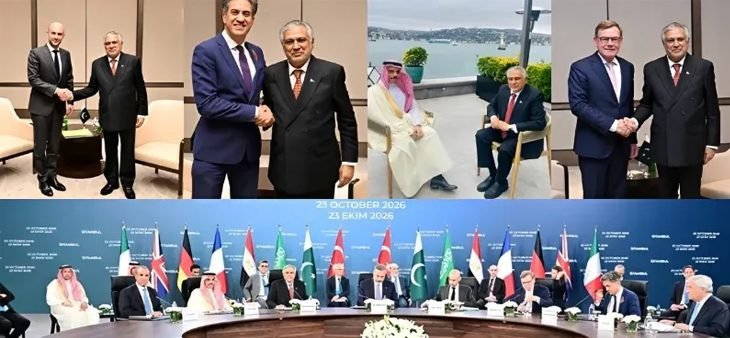
ISTANBUL: Pakistan’s Deputy Prime Minister and Foreign Minister Ishaq Dar has joined regional and European counterparts in Istanbul for diplomatic talks focused on escalating Middle East tensions, regional security and efforts to prevent further conflict. Dar participated in the sixth meeting of the Regional Four (R4), comprising Pakistan, Türkiye, Saudi Arabia and Egypt, followed by an expanded meeting with France, Germany, Italy and the United Kingdom.
The R4 ministers reviewed developments since their previous meeting in New York, with particular attention to regional conflicts and security challenges. They reaffirmed support for Saudi Arabia’s sovereignty and territorial integrity and condemned Houthi attacks targeting the Kingdom. The ministers also discussed ways to improve regional coordination and strengthen diplomatic initiatives aimed at achieving lasting peace and stability.
Dar holds bilateral meetings
On the sidelines of the gathering, Dar met Egyptian Foreign Minister Badr Abdelatty to discuss expanding cooperation in trade, agriculture, pharmaceuticals, renewable energy, defence, connectivity and people-to-people exchanges. Both sides also reviewed developments in Palestine and the wider Middle East.
During talks with Saudi Foreign Minister Prince Faisal bin Farhan Al Saud, Dar reaffirmed Pakistan’s support for the Kingdom’s sovereignty and territorial integrity. The two sides emphasised their strategic partnership and the importance of regular consultations on regional security.
Dar also met British Foreign Secretary Ed Miliband and French Foreign Minister Jean-Noël Barrot to discuss bilateral ties and regional developments. The discussions highlighted the importance of continued diplomatic engagement and cooperation on shared challenges.
In a separate meeting with Turkish Foreign Minister Hakan Fidan, Dar discussed developments in the Middle East and Palestine. Both sides emphasised dialogue and coordinated diplomatic efforts, while reaffirming cooperation under the Makkah Defence Agreement involving Pakistan, Türkiye and Saudi Arabia.
The Istanbul meetings reflect ongoing efforts by the participating countries to coordinate their positions on regional crises and pursue diplomatic solutions to security challenges.