BEIJING: Often dubbed the “Robot Olympics”, China’s growing robotics competitions have evolved from small academic events into major showcases for the country’s rapidly expanding humanoid robotics industry.
The latest and largest event, the five-day World Humanoid Robot Games, began in Beijing on Saturday, highlighting how quickly robotic technology has progressed and how strategically important the sector has become for China.
Robotics competitions in China date back to the period between 1999 and 2014, when events were largely organised for university teams and supported by industry groups and local governments. Early competitions featured relatively simple wheeled robots playing football using limited pre-programmed automation.
A major shift came in 2015, when Beijing hosted its first World Robot Conference. By then, robotics had become a national industrial priority, with President Xi Jinping describing robotics as a key part of advanced manufacturing.
Robot demonstrations gradually became more sophisticated, including mobile robots playing badminton and using sensors to track and respond to moving objects.
By 2023, the World Robot Conference had developed into a major commercial showcase, with established technology companies using the event to demonstrate new products. Attention also increasingly focused on China’s ability to produce robots and components at relatively low prices.
Xiaomi’s CyberDog, for example, attracted widespread attention as a comparatively affordable quadruped robot. The device was introduced at around $1,500, far below the price of Boston Dynamics’ Spot, which was selling for more than $75,000.
The development of humanoid robots accelerated sharply in 2025 and 2026. In April 2025, humanoid robots took part alongside human runners in what was described as the world’s first robot half-marathon in Beijing.
The event exposed the limitations of the technology at the time. Many robots failed to complete the course, with some collapsing soon after the start while others lost control and crashed into barriers.
A year later, performance had improved dramatically. During the second Beijing half-marathon, a Unitree H1 humanoid completed the final stretch without a human accompanying it.
State media reported that 47 of more than 100 robot teams entered in 2026 completed the competition.
One of the most notable performances came from Honor’s humanoid robot “Flash”, which reportedly completed the half-marathon autonomously in 50 minutes and 26 seconds, a time faster than the human world record set shortly beforehand.
Analysts and industry executives have attributed the rapid progress to China’s increasingly competitive robotics supply chain, government support and declining component costs.
China’s government has played an active role in the sector’s development. A 2021 five-year plan for robotics included subsidies, research incentives and financing support, with the stated aim of making China a major global centre for robotics innovation.
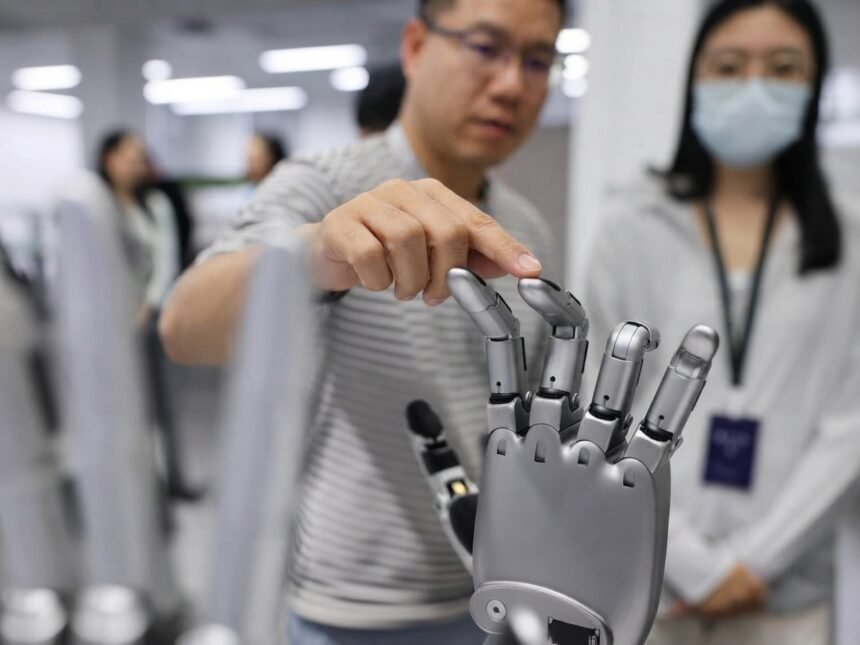
The 2026 World Humanoid Robot Games have also introduced competitions focused on robotic hands, reflecting a shift from entertainment and demonstrations towards practical industrial applications.
Robots are being tested on tasks such as tightening screws, opening bottles and picking up small objects with tweezers. Engineers consider robotic hands among the most difficult components to develop because they must combine speed, precision and a sense of touch.
The growing emphasis on real-world tasks reflects one of the biggest challenges facing the industry: proving that humanoid robots can move beyond impressive demonstrations and become useful, reliable tools in workplaces and everyday environments.