
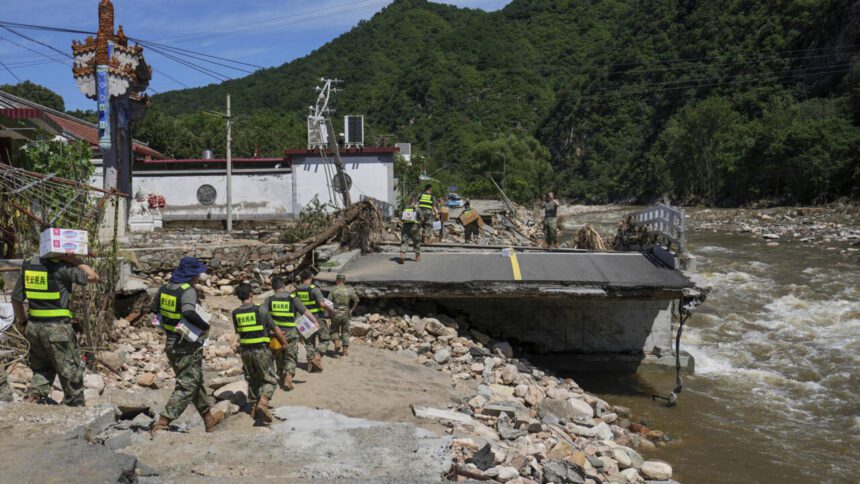
At least 70 people have died in northern China following a week of relentless torrential rain that unleashed catastrophic floods across Beijing and nearby regions between 23 and 29 July. Authorities reported that rainfall in Beijing averaged 166mm, matching the city’s monthly norm, while Miyun district alone received a staggering 543mm equal to its usual yearly total.
The casualties include 31 elderly residents at a Miyun care home, 10 passengers swept away in a minibus in Shanxi province, and eight victims of a landslide in Chengde. The floods severely damaged roads and infrastructure, isolating more than 130 rural villages and forcing the evacuation of over 80,000 people.
Experts link the surge in extreme rainfall events across China to climate change, noting that each degree of global warming allows the atmosphere to hold about 7% more moisture, intensifying downpours.
Meanwhile, Japan is bracing for Tropical Storm Krosa, forecast to pass near the Izu Islands and skirt the Kanto region. While the storm is expected to avoid a direct hit, forecasters warn it could dump 120-200mm of rain within 24 hours in parts of Chiba.
Elsewhere in Europe, Scandinavia is enduring an unprecedented heatwave. In mid-July, temperatures surged 8-10°C above normal in Norway, Sweden, and Finland, fueled by abnormally warm sea-surface temperatures off Norway and a persistent high-pressure system. In Norway’s Trøndelag and Nordland, the heat exceeded 30°C for 13 straight days, marking the warmest two-week stretch on record.
Over the past week, the heat shifted north and east, easing slightly in Norway and Sweden but intensifying across Finland and northwestern Russia, where readings remain 10-15°C above average. Forecasts predict temperatures in the upper 20s Celsius to persist for at least five more days, extending hundreds of miles beyond the Arctic Circle.