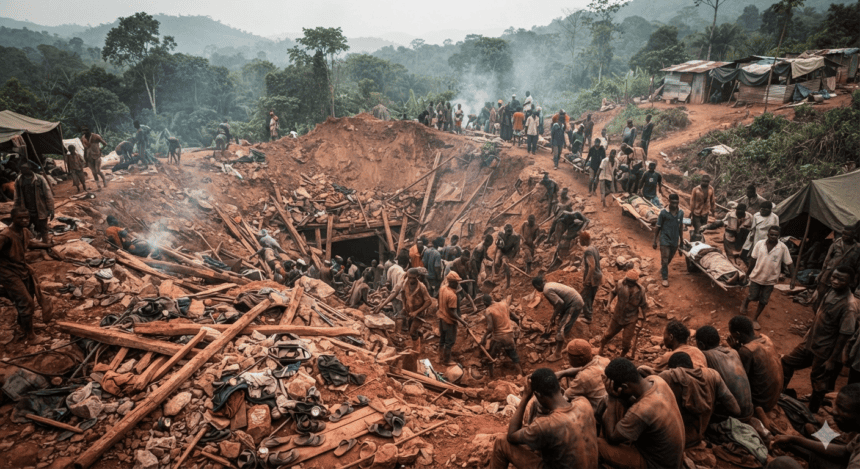
NDASSIMA — A gold mine collapsed in the Central African Republic’s Ouaka prefecture early Tuesday, killing at least 100 miners. Local authorities confirm the death toll is expected to rise as rescue crews dig through unstable soil with little more than hand tools.
The disaster struck in a remote, unregulated mining zone near the town of Ndassima. Heavy rains throughout the week saturated the ground, turning the makeshift mine pits into death traps. When the walls gave way, dozens of workers were buried instantly.
“The earth simply swallowed them,” said a local official who arrived at the site shortly after the collapse. “We don’t have heavy machinery here. We are digging with shovels and our hands, but the chances of finding anyone alive are near zero.”
Mining remains a dangerous gamble for thousands in the region. Many laborers operate in informal, artisanal pits—sites that lack even the most basic safety reinforcement. These mines are often the only source of income for families living in extreme poverty, leaving workers with little choice but to risk cave-ins for a few grams of gold.
The central government in Bangui has struggled for years to exert control over these remote mining hubs. Many of the sites are either managed by local militias or operate entirely outside the reach of state regulation. Tuesday’s tragedy highlights the lethal cost of this lack of oversight.
While rescue efforts continue, families have begun gathering at the edge of the pit, waiting for news. Some are already preparing for burials.
The scale of the disaster has overwhelmed local medical facilities, which lack the equipment to handle mass-casualty events. With no specialized search-and-rescue teams arriving from the capital, the local community remains the only line of defense against a growing list of dead.
For the families of Ndassima, the gold that promised a way out of poverty has instead become a mass grave.