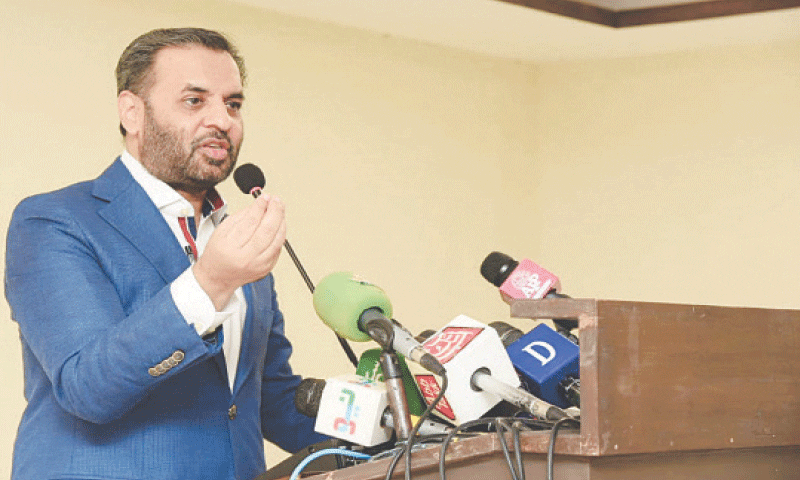
Federal Health Minister Mustafa Kamal informed the Senate Standing Committee on Health yesterday that the health budget for the current fiscal year has been reduced by 33 percent compared to the previous year’s allocation.
He said that last year, the ministry’s budget was Rs 21 billion, which has now been reduced to Rs 14 billion. No new project has been initiated this year. Although 12 new projects were proposed, no funds were allocated for them, causing delays in their implementation.
The Federal Health Minister stated that all ongoing projects are being run within the limits of the approved budget.
The committee meeting was chaired by Senator Aamir Waliduddin Chishti and attended by Senators Syed Masroor Ahsan, Muhammad Humayun Mohmand, Dilawar Khan, Anusha Rehman Ahmed Khan, Samina Mumtaz Zehri, and Dr. Zarqa Suharwardy Taimur, along with officials from the ministry.
The Federal Minister reiterated that 12 new projects were proposed, but no funds were earmarked for them.
Senator Anusha Rehman emphasized the need to introduce a comprehensive healthcare card to provide medical facilities to the public and offer relief to taxpayers.
However, Mustafa Kamal explained that healthcare card facilities exist in some provinces but are unavailable in others. He mentioned that the Sindh government has taken responsibility for providing healthcare facilities in Tharparkar. Although the healthcare card system has not yet been launched in Sindh, 16 hospitals in the province are offering free treatment to the public.
Senator Anusha Rehman observed that hospitals are witnessing struggles primarily for administrative positions. She stressed the need to examine why doctors are taking administrative posts and emphasized that doctors should be appointed for patient care rather than administration.
Senator Samina Mumtaz Zehri called for improving doctors’ behavior and attitude, pointing out that medico legal officers are often absent from duty and that government hospitals lack basic facilities.
Senator Muhammad Humayun Mohmand said that renowned doctors are opposing the health card system because their consultation fees are very high. He added that more than half of the consultants do not perform their duties regularly and suggested that since PIMS receives Rs 6 billion annually, it should be handed over to another administrative body.
While discussing the shortage of doctors, Federal Minister Mustafa Kamal said that around 22,000 doctors graduate in Pakistan every year, but a large number of female doctors do not practice after completing their degrees.
Medicine Prices:
The committee also discussed one of its agenda items, directing the ministry to present a comprehensive report on medicine prices, including details of hardship cases and new registrations, so they can be reviewed in the next meeting.
The Federal Minister stated that the issue of medicine prices is highly sensitive and requested the chairman to convene an in camera meeting of the committee on this matter, to which the chairman agreed.