Earth spent its first few hundred million years as a hellscape of molten rock and toxic gases. Then, the impossible happened. Chemistry became biology.
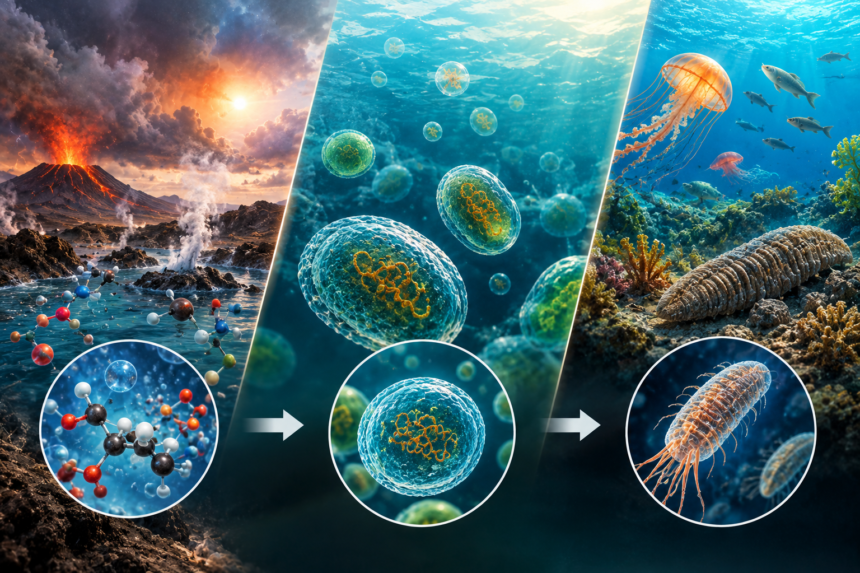
Scientists have long debated how a dead planet birthed a living one, but recent research into the Last Universal Common Ancestor (LUCA) and ancient geological signatures has narrowed the mystery down to three specific, high-stakes transitions. Without any one of these “accidents,” Earth would still be a silent rock.
The First Spark: The RNA World
The first hurdle wasn’t biological—it was a coding problem. Before there were cells or DNA, there had to be a way to store information and catalyze reactions.
Most researchers now point to the “RNA World” hypothesis. Unlike DNA, which needs proteins to function, RNA can do both: store genetic blueprints and act as an enzyme. This transition likely happened in mineral-rich environments—think deep-sea hydrothermal vents or volcanic “warm little ponds”—where chemical energy was high enough to force simple molecules into complex chains. It was the first time matter on Earth began to remember itself and replicate.
The Oxygen Revolution
For nearly two billion years, life was a slow, anaerobic crawl. The organisms that existed didn’t need oxygen; in fact, oxygen was a lethal poison to them.
Then came the Great Oxidation Event. Around 2.4 billion years ago, a group of organisms called cyanobacteria “invented” oxygenic photosynthesis. They started using sunlight to split water, releasing oxygen as a byproduct. It was the planet’s first mass extinction, but it was also a massive energy upgrade. Oxygen allowed for aerobic respiration—a way to extract far more energy from food. This surplus energy is the only reason life grew larger than a microscopic speck.
The Great Merger
The final turning point wasn’t a slow evolution, but a sudden, biological merger. Roughly 1.5 billion years ago, one simple cell swallowed another.
Instead of digesting its prey, the host cell kept it alive. That swallowed cell eventually became the mitochondria—the “powerhouse” that drives every complex cell today. This event, known as endosymbiosis, happened only once in billions of years. It broke the “glass ceiling” of size and complexity. Every plant, animal, and human alive today is a direct descendant of that single, accidental partnership.
The Bottom Line
We often think of evolution as a steady climb, but the history of life suggests otherwise. It was a series of radical, chaotic shifts—a chemical fluke, a planetary poisoning, and a microscopic merger.
“We are looking at a series of bottlenecks,” says one leading evolutionary biologist. “If the chemistry hadn’t clicked in those specific ways, the universe would have one less living world.” Life didn’t just appear; it fought its way through three distinct chemical and biological revolutions to get here.