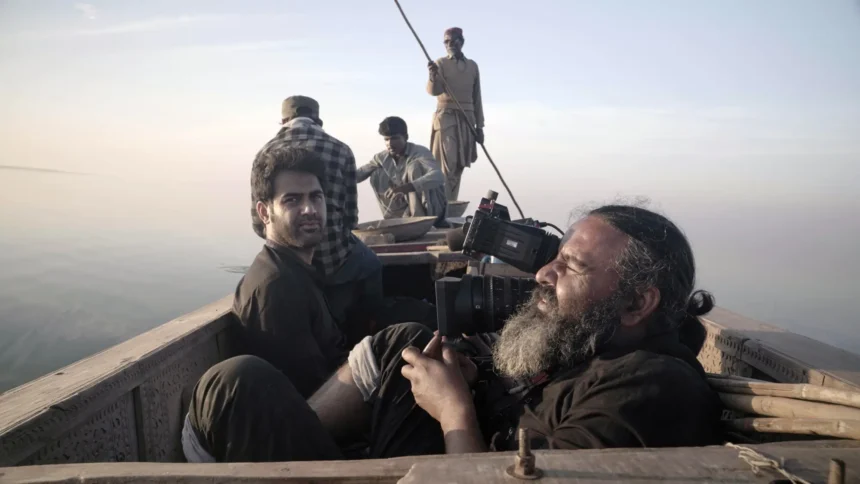
In a time when cultural roots are vanishing faster than ever, Pakistani filmmaker Jawad Sharif has brought to life one of the country’s most overlooked and endangered communities — the Mohanas of Manchar Lake — through his deeply moving documentary, “Moklani: The Last Mohanas.”
The film isn’t just another documentary. It’s a tribute, a cry for help, and a cinematic record of a people who’ve lived for centuries on the water, now struggling to survive in a world that’s changing too fast for them to keep up.
The People of the Lake
For generations, the Mohanas — often called the “boat people” of Sindh — have lived on Manchar Lake, one of South Asia’s largest freshwater lakes. Their entire life floats: homes, schools, even small markets, all set on wooden boats that drift across the still waters.
Fishing is their lifeline, storytelling their tradition, and the lake — their only world. But that world is shrinking. Pollution, drought, and climate change have poisoned the lake and dried up its spirit. The once thriving Mohana culture is now at risk of fading into history.
Jawad Sharif captures this slow disappearance with heartbreaking intimacy. His lens doesn’t just observe — it listens. Viewers meet families who have lost their boats, children who can’t go to school, and elders who remember a time when the lake was alive.
“It’s not just their home that’s dying,” Sharif said in an interview. “It’s an entire culture, a living heritage, being erased in silence.”
A Global Win for a Local Story
Moklani: The Last Mohanas recently made history by winning the Global Voices Award at the 2025 Jackson Wild Media Awards — often called the “Oscars of nature films.”
The achievement marks the first time a Pakistani film has won at this globally respected event, which celebrates powerful storytelling about the environment and indigenous communities.
Judges selected Moklani from over 500 entries worldwide, praising its visual honesty and emotional depth. The film stood out for giving a human face to a crisis that’s both ecological and cultural.
“This honour belongs to the Mohana community,” Sharif said after the win. “They trusted me with their stories. The world is finally hearing their voice.”
Why the Film Matters
Moklani goes beyond just environmental awareness — it’s about identity, belonging, and survival.
Cultural Preservation – The documentary immortalizes fading songs, dialects, and traditions of the Mohanas that might otherwise vanish without a trace.
Environmental Awareness – It connects the local tragedy of Manchar Lake to broader issues of water management, pollution, and climate change in South Asia.
Representation of the Marginalized – The film lets the Mohanas speak for themselves, shifting the lens from pity to empowerment.
Sharif’s storytelling brings a haunting realization — when the lake dies, a piece of Pakistan’s soul goes with it.
A Wake-Up Call for Policy Makers
Despite international applause, the Mohanas remain one of Pakistan’s most neglected communities. With no formal rights over land or water, limited access to education and healthcare, and increasing displacement, their survival depends on more than awareness — it needs policy action.
Experts say that preserving Manchar Lake and its people requires urgent intervention: clean water projects, sustainable fishing programs, and cultural documentation to ensure future generations don’t forget who the Mohanas were.
Moklani is not just a film — it’s a reminder of what’s at stake when progress forgets its roots.
The Legacy of Storytelling
Jawad Sharif has built a career out of giving voice to Pakistan’s hidden stories. From Indus Blues to K2 and the Invisible Footmen, his work often explores the fragile bond between people and nature.
With Moklani, he’s done something even deeper — he’s made the invisible visible. The documentary isn’t just about the Mohanas; it’s about all the voices we risk losing if we stop listening.
And in that sense, it’s not just their story. It’s ours too.
Jawad Sharif’s “Moklani: The Last Mohanas” Gives Voice to a Disappearing Culture


Leave a Comment