
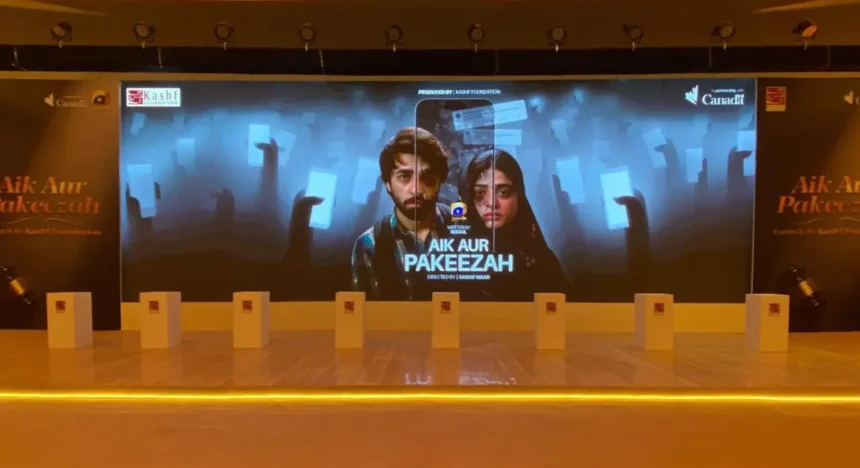
In an age where a single forwarded video can upend a life, Kashf Foundation’s new drama Aik Aur Pakeezah arrives with unsettling relevance. The series, set to air on Geo TV, tackles cybercrime, digital harassment, and the quiet devastation that follows when a woman becomes the target of online manipulation.
At the centre of the story is Pakeezah, played by Sehar Khan. Her world unravels after an altered video of her spreads online — a clip fabricated with the kind of ease and cruelty that has become disturbingly common. What begins as a digital assault quickly spills into the real world: social stigma, pressure to marry against her will, and the painful silence that often greets victims before they even approach the law.
A story rooted in reality, not melodrama
Kashf isn’t new to difficult subjects, but this time the foundation has stepped into the digital battlefield. Before writing began, the creative team sifted through real case studies, testimonies, and data on online harassment in Pakistan. They wanted accuracy, not shock value.
And it shows.
The drama doesn’t sensationalise the crime. It focuses on what happens next — the guilt that shouldn’t exist but does, the whispered judgments, the family dynamics that shift overnight, and the labyrinth victims must navigate just to be heard.
Nameer Khan plays a character who exposes another dimension of the problem: the harassment men face online and the dismissive tone society often takes when they come forward. His storyline mirrors Pakeezah’s in unexpected ways, highlighting how digital harm cuts across gender even though society reacts differently depending on the victim.
A timely intervention in a rapidly digitising country
Pakistan now has hundreds of millions of internet users, and alongside the growth has come a surge in cyber harassment cases. Many never make headlines. Many never get reported at all.
Aik Aur Pakeezah holds up a mirror to that silence.
Kashf hopes viewers walk away with discomfort — the productive kind. The kind that forces families to talk about online safety, about shame culture, about why victims end up fighting not just their abusers but entire social ecosystems.
A drama with a purpose, not just a plot
The Foundation’s earlier productions have dealt with forced marriage, child abuse, trafficking — topics often avoided in mainstream entertainment. This latest project extends that mission into the digital age, where harm is often invisible but just as destructive.
If Aik Aur Pakeezah succeeds, it won’t be because it delivered a twist or a villain to hate. It will be because it makes viewers ask harder questions:
How easily do we believe the things we see online?
Who do we blame when something goes wrong?
And what does justice look like for someone whose suffering began with a single click?
Kashf isn’t trying to entertain. It’s trying to warn, to educate, and to shift the burden away from victims who’ve spent far too long carrying it alone.