
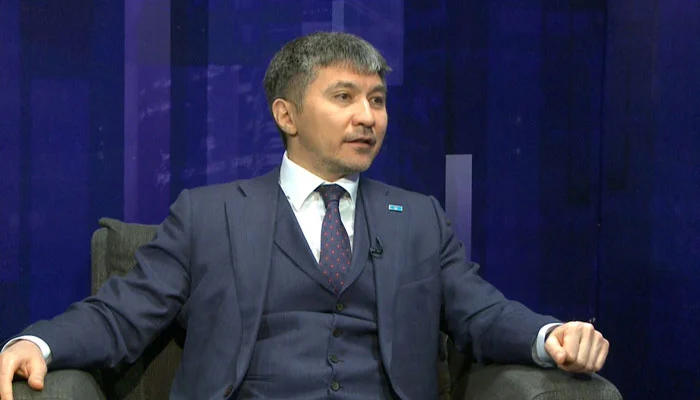
ISLAMABAD: Kazakhstan’s ambassador to Pakistan, Yerzhan Kistafin, has outlined an ambitious railway project that could reshape regional trade by linking Central Asia directly with Pakistan’s ports on the Arabian Sea.
Speaking exclusively to Geo News in Islamabad, Ambassador Kistafin said the proposed rail corridor—stretching from Kazakhstan through Turkmenistan and Afghanistan into Pakistan—represents the continuation of a long-standing regional vision rather than a new initiative.
“What we are doing today is part of a long-term strategy,” he said. “What has changed is the political will to move from discussion to execution.”
At the heart of the plan is a railway route that would pass through Turkmenistan and Afghanistan before entering Pakistan at Chaman, linking with the national rail network and extending south to Karachi and Gwadar. If completed, the project would give landlocked Central Asian states direct access to warm waters for the first time in modern history.
Ambassador Kistafin credited Prime Minister Shehbaz Sharif with maintaining Pakistan’s Central Asia policy despite domestic political changes.
“Prime Minister Shehbaz Sharif is a pragmatic and results-oriented leader,” he said. “His government focuses on delivery rather than ceremonial diplomacy.”
According to the ambassador, discussions between Pakistan and Central Asian states have now shifted from declarations to concrete matters such as financing, timelines, and implementation mechanisms.
Bilateral trade between Pakistan and Kazakhstan currently stands at around $300 million annually—a figure both sides believe significantly understates the true potential.
“The issue is not trade capacity,” Kistafin said. “The issue is access.”
At present, goods moving between the two countries must transit multiple states, leaving trade vulnerable to border closures, political tensions, and security disruptions. Rail connectivity, he argued, offers stability that diplomacy alone cannot ensure.
“A train does not depend on political moods,” he said. “It depends on tracks.”
The Afghan segment—often considered the most challenging part of the project—runs from Turkmenistan’s border town of Turgundi to Chaman, covering approximately 687 kilometres. Construction is expected to take about three years once final agreements are signed.
Kazakhstan has committed to fully financing the project.
“We are not asking Pakistan for a single penny,” Kistafin said. “This is not aid—it is an investment with shared benefits.”
He stressed that Afghanistan should be viewed as a partner rather than an obstacle, noting that Kazakhstan has engaged Afghan authorities in multiple rounds of dialogue in coordination with Pakistan and Turkmenistan.
“Connectivity creates responsibility,” he said. “Trade creates incentives for peace.”
If realised, the corridor would integrate Pakistan into two major Eurasian trade networks—the North–South International Transport Corridor and the Trans-Caspian Middle Corridor—neither of which currently includes Pakistan.
For Central Asia, the route would offer the shortest access to the Arabian Sea. For Pakistan, it would position the country as a key transit hub linking South Asia with Central Asia, the Caucasus, Türkiye, Russia, and Europe.
Economic projections are substantial. Following Ambassador Kistafin’s meeting with the Pakistan Business Council in Karachi in December 2024, an independent assessment estimated that bilateral trade between Pakistan and Kazakhstan alone could rise to $14 billion once logistical constraints are removed.
“That figure is only for two countries,” the ambassador noted. “It does not include the rest of Central Asia.”
Momentum for the project increased after the historic visit of Pakistan’s Army Chief, Field Marshal Asim Munir, to Kazakhstan last year. During the visit, he held talks with President Kassym-Jomart Tokayev and senior officials on defence cooperation, infrastructure security, and regional connectivity.
“Field Marshal Asim Munir understands that economic security and national security are inseparable,” Kistafin said, describing the army chief as a visionary leader.
Beyond infrastructure, Kazakhstan has taken steps to enhance people-to-people ties. Business visas for Pakistani nationals are now issued within two days, tourism cooperation agreements have been finalised, and direct flights between the two countries are expected to resume later this year.
Issues related to illegal migration and human trafficking have been addressed through coordination between Kazakhstan’s migration authorities and Pakistan’s Federal Investigation Agency, with further security agreements expected during upcoming high-level engagements.
For decades, Central Asia’s trade routes have pointed north and east, while Pakistan’s focus remained maritime. The proposed railway charts a new direction—turning geography from a constraint into an opportunity.
“This project is not only about trains,” Ambassador Kistafin said. “It is about changing the direction of history.”
Whether regional politics, security dynamics, and timelines align remains to be seen. But for the first time in generations, a tangible route is being drawn—steel tracks cutting across borders, pointing south, and promising to connect regions long separated not by distance, but by missing links.