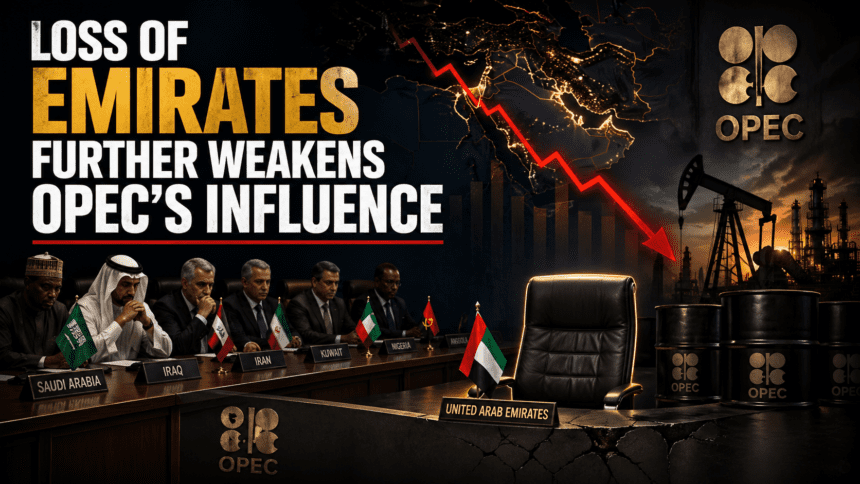
The United Arab Emirates’ decision to leave OPEC has opened a new crack inside one of the world’s most important oil alliances, and it comes at a moment when the group’s authority already looks more fragile than it once did. The UAE announced on April 28 that it will quit OPEC effective May 1, 2026, ending a membership that stretches back decades and removing one of the cartel’s biggest producers from the table.
That matters because the UAE is not some symbolic player. It is OPEC’s third-largest producer, and, more importantly, one of the few members with meaningful spare capacity. In plain terms, it is one of the countries that can actually raise output when markets tighten. Losing that kind of member does not just shrink OPEC on paper; it weakens the group’s practical ability to steer supply and shape prices.
The split did not come out of nowhere. Reports say Abu Dhabi had grown increasingly frustrated with production limits that capped its earnings and market share even as it expanded capacity and pushed for more room to pump. The UAE has been aiming to lift production capacity toward 5 million barrels a day by 2027, a target that sat awkwardly beside quota systems designed to keep members restrained.
There is also a bigger strategic story behind the move. The UAE has been trying to position itself not only as a major oil exporter, but as a broader energy and investment power with more freedom to respond to market demand on its own terms. That makes cartel discipline harder to sell at home, especially when the global energy transition is already pressuring oil producers to monetize reserves while they still can.
For OPEC, the damage is as much political as it is commercial. The group was built on coordinated action, and its influence depends heavily on the idea that major producers can move together. When a heavyweight member walks away, it sends a message that national interest now outweighs collective discipline. Analysts quoted in current coverage say the result could be a more fragmented market, more volatility, and less certainty that OPEC can enforce the kind of unity that once made traders jump on every production statement.
In the immediate term, oil prices are still being shaped by wider regional turmoil, including disruption tied to tensions around the Strait of Hormuz. So the UAE’s exit does not instantly redraw the supply map overnight. But over the longer run, this is the sort of break that chips away at OPEC’s credibility. A cartel is only as strong as its ability to keep its most capable members aligned, and right now that looks harder than ever.
What makes this especially awkward for OPEC is timing. Just weeks ago, official OPEC communication still listed the UAE among the countries coordinating voluntary adjustments to support market stability. Now, suddenly, one of those same key producers is heading out the door. That sharp turn underscores how thin the cohesion had become beneath the surface.
So yes, the loss of the Emirates further weakens OPEC’s influence. Not because the organization disappears without it, and not because Saudi Arabia stops mattering. But because OPEC has now lost a wealthy, ambitious, low-cost producer that still had room to grow. That is the kind of departure markets remember.