

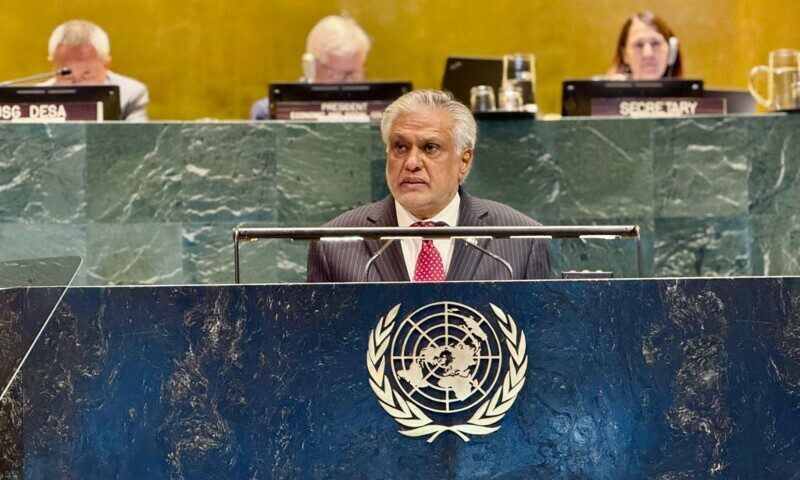
Pakistan is aiming to meet 60% of its energy needs through renewable sources by 2030, Deputy Prime Minister and Foreign Minister Ishaq Dar announced during his address at the United Nations High-Level Political Forum (HLPF) in New York. His remarks came during Pakistan’s presidency of the UN Security Council (UNSC) for the month of July, marking the country’s eighth term as a non-permanent member.
Dar reaffirmed Pakistan’s commitment to the 2030 Agenda for Sustainable Development, highlighting ongoing reforms in energy, climate resilience, and social uplift. He cited national initiatives like the Benazir Income Support Programme, Recharge Pakistan, and the Living Indus project as critical to achieving SDG-aligned progress.
“Despite the compounded impacts of global crises—ranging from the pandemic to climate shocks—Pakistan is fully committed to implementing sustainable development goals,” Dar stated. He added that the Special Investment Facilitation Council (SIFC) is actively working to align foreign investments with national development priorities.
Dar emphasized the importance of a reformed global financial architecture to bridge the SDG financing gap, urging developed nations to expand access to concessional finance, debt relief, and climate funding for the Global South.
Dar Meets UN Chief, Raises Key Regional Issues
In a separate meeting with UN Secretary General António Guterres, Dar reiterated Pakistan’s strong commitment to multilateral diplomacy and the principles of the UN Charter. Guterres acknowledged Pakistan’s proactive role at the Security Council.
Dar stressed the urgent need for a peaceful resolution to the Jammu and Kashmir dispute in line with UN resolutions. He also raised concerns over violations of the Indus Waters Treaty and externally supported terrorism targeting Pakistan.
He reaffirmed Pakistan’s support for a sovereign Palestinian state and called for an immediate ceasefire in Gaza. The FM also welcomed the recent appointment of a UN Special Envoy on Islamophobia, expressing Pakistan’s commitment to combating religious intolerance globally.
Dar will chair a high-level UNSC briefing on enhancing cooperation between the UN and the Organisation of Islamic Cooperation (OIC) and is also set to attend the rescheduled International Conference on the Two-State Solution on July 28–29, co-hosted by Saudi Arabia and France.
His itinerary includes multiple bilateral meetings with global counterparts and senior UN officials. Dar is also expected to meet with US Secretary of State Marco Rubio during his stay.





Impressive commitment from Pakistan on renewables—60% by 2030 is a bold step toward SDG 7, especially with initiatives like Recharge Pakistan and Living Indus tackling climate shocks. The BISP expansion is spot on for social uplift, and Dar’s push for global finance reform highlights the Global South’s needs. Excited for the UNSC events—hoping for progress on Kashmir and Gaza too!