
Pakistan is charting a bold course in space exploration with plans to launch its first lunar mission by 2035, according to Minister for Planning, Development and Special Initiatives Ahsan Iqbal. The announcement marks a historic leap for Pakistan’s space agency, Suparco, under the country’s growing scientific and technological ambitions.
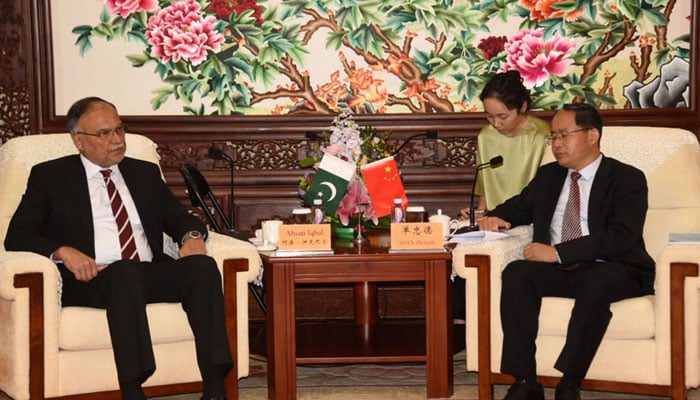
Speaking during a high-level meeting in Beijing with Shan Zhongde, Chairman of China’s Atomic Energy Authority and Space Agency, Iqbal said the lunar mission would be developed under the Uraan Pakistan initiative a national program aimed at accelerating advancements in space science and technology.
The minister also revealed that Pakistan will send its first astronaut to China’s Tiangong Space Station by 2026, in what would be another landmark for the country’s growing collaboration with China in the aerospace domain.
“Pakistan has entered a new era in scientific innovation under Prime Minister Shehbaz Sharif’s vision,” Iqbal said. “Our recent success in launching three satellites with Chinese cooperation demonstrates the momentum we’ve gained.”
In addition to space ambitions, the minister called for deepened collaboration with China in peaceful nuclear energy, quantum computing, and climate resilience. “As climate change increasingly threatens our water, food, and health security, the shift towards alternative energy and advanced tech is no longer optional it is imperative,” he said
Iqbal praised joint ventures like the K-2, K-3, and C-5 nuclear power plants as symbols of strategic trust and partnership between the two nations. He also highlighted Pakistan’s newly established Quantum Computing Center, aimed at integrating cutting-edge technology with the country’s development goals.
The minister urged for increased educational exchange programs to support young Pakistani scientists and engineers, noting that “knowledge-sharing is the backbone of sustainable development.”
Chairman Shan Zhongde welcomed Pakistan’s technological strides and reaffirmed China’s commitment to strengthening bilateral cooperation in space research, nuclear energy, and scientific innovation. He commended the progress made under the China-Pakistan Economic Corridor (CPEC), which he said had helped Pakistan overcome key infrastructure and energy challenges.
As Pakistan looks toward the moon and beyond, this strategic partnership with China appears poised to play a central role in shaping the country’s scientific future.