
Imagine a small village where the river once flowed clear and strong. People drew clean water, fields stayed green, and children ran freely without worry. But as time passed, families grew, houses expanded, and soon the same river struggled to meet the needs of thousands. Water turned scarce, fields dried, and life became heavier for everyone.
- A Century of Unstoppable Growth
- When Needs Grow Faster Than Resources
- The Hidden Cycle: Health → Education → Poverty
- Inflation: The Silent Enemy
- But There’s Another Enemy in the Room: Corruption
- Climate Change: Turning Struggles Into Disasters
- Cities Swelling Beyond Limits
- What Can Be Done?
- A Final Thought: Action Must Replace Promises
This is not just a village’s story.
This is our world’s story.
This is Pakistan’s story.
A Century of Unstoppable Growth
Over the last century, the world’s population has multiplied at a breathtaking speed. In 1950, we were 2.5 billion people. Today, we stand at almost 8 billion.
Better healthcare, longer lives, and higher birth rates pushed these numbers up but the world wasn’t prepared for the challenges that came with it.While developed countries adapted, developing nations like Pakistan fell into a cycle where more people meant fewer resources, weaker systems, and deeper poverty.
When Needs Grow Faster Than Resources
As our population grows, our needs grow even faster. Water, food, healthcare, and education everything becomes limited. You don’t have to be an economist to understand what happens next:
- Water runs short
- Food supplies shrink
- Hospitals overflow
- Schools cannot keep up
A family that once had enough now finds itself struggling to afford basic meals. A child that could have had a future is forced to stay home because schools are already full. A patient who could be saved loses their life because medical care simply isn’t enough for everyone. And this isn’t happening far away it’s happening right here, in our streets, our neighborhoods, and our cities.
The Hidden Cycle: Health → Education → Poverty
Experts often say poverty is not caused by just one problem it’s a circle. Poor health leads to poor education.
Poor education leads to poor jobs.
Poor jobs lead to deeper poverty.
In Pakistan, nearly 40% of children suffer from stunting meaning their growth is halted because they don’t get enough nutrition. Half of our girls are unable to attend school. When a child begins life with these disadvantages, breaking free becomes almost impossible. It’s like trying to climb a mountain with hands tied.
Inflation: The Silent Enemy
As the population grows, demand rises and so do prices. Food, rent, healthcare, transportation everything becomes costlier. The poorest families suffer the most; even basic necessities slip further from their reach. Inflation doesn’t just empty pockets.It empties futures.
But There’s Another Enemy in the Room: Corruption
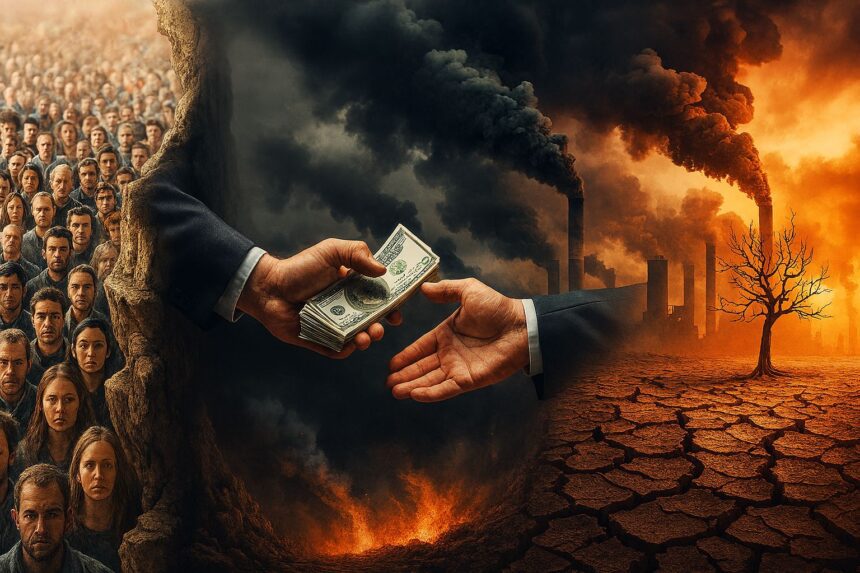
During a recent event, Pakistan’s Finance Minister identified population growth and climate change as “two existential threats.” Yet, the IMF warns that corruption is the real root of the crisis the silent force weakening every institution.
Corruption steals money meant for hospitals, schools, clean water, roads, and electricity. It steals opportunities from millions. It steals the dignity of those who have no voice.Without confronting corruption, no economic plan, no policy, no reform can truly succeed.
Climate Change: Turning Struggles Into Disasters
Climate change is not just melting glaciers or warming seas it is reshaping everyday life in Pakistan. Droughts, floods, heatwaves, and unpredictable seasons hit the poorest communities the hardest.
When crops fail, food becomes scarce.
When water dries up, migration accelerates.
When floods hit, entire towns collapse. Population growth puts pressure on the environment and climate change pushes back even harder.
Cities Swelling Beyond Limits
As conditions worsen in rural areas, people rush to cities for survival. Karachi, Lahore, and other major cities are expanding faster than they can handle. Katchi abadis (slums) multiply, often without clean water, sanitation, or education.The dream of a better life turns into a daily struggle to survive.
What Can Be Done?
There is no single miracle solution but there are steps that can change the story:
1. Invest in education especially for girls
Educated women reduce poverty, improve family health, and build stronger communities.
2. Improve healthcare access
Healthy people build healthy economies.
3. Manage resources wisely
New technologies and smarter planning can save water, increase food production, and distribute services more fairly.
4. Create jobs and support small businesses
When people earn, families rise. Entire communities rise.
5. Eliminate corruption with real accountability
Without this, nothing else will work.
A Final Thought: Action Must Replace Promises
Population growth, corruption, and climate change are not separate issues. They are interconnected and together they create a crisis that threatens Pakistan’s very foundations.
We cannot keep waiting for change.
We must demand it.
We must build it.
If corruption ends, resources will reach the people.
If resources reach the people, education and health will improve.
If opportunities grow, poverty will fall. And if poverty falls, Pakistan can finally rise. This is not just a story.
This is our reality.
And it is still in our hands to rewrite it.