

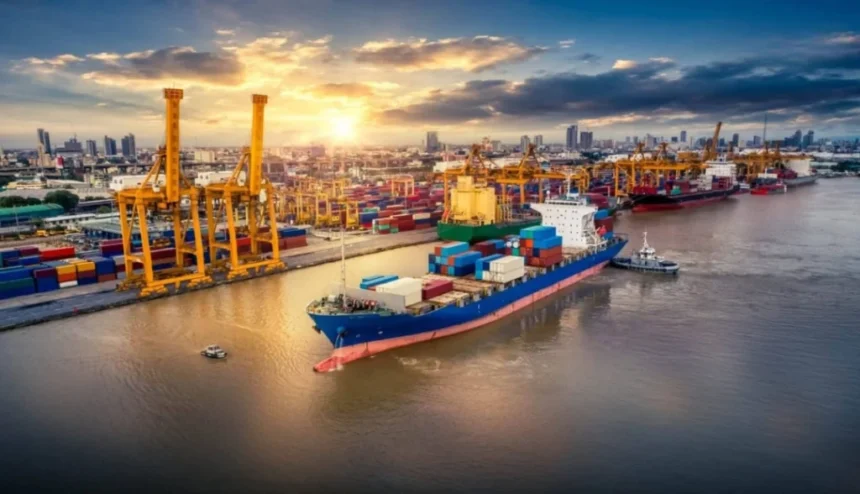
ISLAMABAD:Pakistan’s Port Qasim has earned a place among the world’s top 20 most improved ports, with the World Bank ranking it ninth in its latest global Container Port Performance Index (CPPI) 2024.
The report, compiled with S&P Global Market Intelligence, highlights that Port Qasim boosted its performance score by 35.2 points between 2020 and 2024 an achievement the government says reflects years of reforms, modernization, and efficiency upgrades.
Federal Minister for Maritime Affairs Muhammad Junaid Anwar Chaudhry hailed the milestone as a “matter of national pride,” noting that the recognition underscores Pakistan’s determination to transform its maritime facilities into competitive regional hubs. He said policy reforms, investment in digital systems, and adoption of international best practices were driving the sector forward.
The minister also credited private operators, particularly DP World’s Qasim International Container Terminal (QICT), for maintaining global standards in port management. He announced approval of a long-pending dredging project to deepen the channel, which will allow larger ships to dock and further expand trade capacity.
Port Qasim Authority (PQA) Chairman Rear Admiral (Retd) Moazzam Ilyas praised the workforce for the accomplishment, calling the World Bank’s acknowledgment proof of the team’s dedication. He reaffirmed PQA’s commitment to innovation, digitalization, and infrastructure upgrades.
Officials said Port Qasim’s rise strengthens Pakistan’s bid to position itself as a strategic logistics corridor linking the Middle East, Central Asia, China, and beyond. With Karachi and Gwadar ports also undergoing modernization, Pakistan aims to attract foreign investment, reduce shipping costs, and offer exporters more reliable trade routes.
“This achievement is only the beginning,” Chaudhry said. “Our next step is to integrate ports with inland transport networks, expand digital systems, and ensure environmental sustainability, so that Pakistan’s maritime gateways become engines of growth and regional connectivity.”