
LAHORE
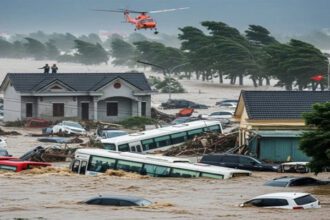
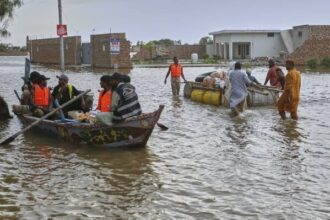
Severe flooding has gripped Punjab after India released large volumes of water into eastern rivers, forcing authorities in Pakistan to evacuate more than 210,000 people to safety. The National Disaster Management Authority (NDMA) confirmed that the Pakistan Army, Rangers, Rescue 1122, and Provincial Disaster Management Authorities (PDMAs) are working together in rescue operations, with no casualties reported so far.
NDMA Chairman Lt. Gen. Inam Haider Malik said all evacuees have been shifted to government run relief camps, where they are receiving food, medicine, and essential supplies. Water levels in the Sutlej and Chenab are still rising, with Panjnad’s flow projected to reach 700,000 cusecs, sparking fears of worsening floods downstream at Kotri and Guddu barrages.
Holy Sikh site submerged
Authorities carried out a controlled blast at Qadirabad Dam’s embankment to reduce water pressure, but the move left Kartarpur’s Gurdwara Darbar Sahib one of Sikhism’s holiest sites completely submerged. Rescue boats evacuated around 100 stranded people from the flooded shrine. Visuals from Narowal showed the sacred site underwater after the Ravi River overflowed.
Rising threats across Punjab
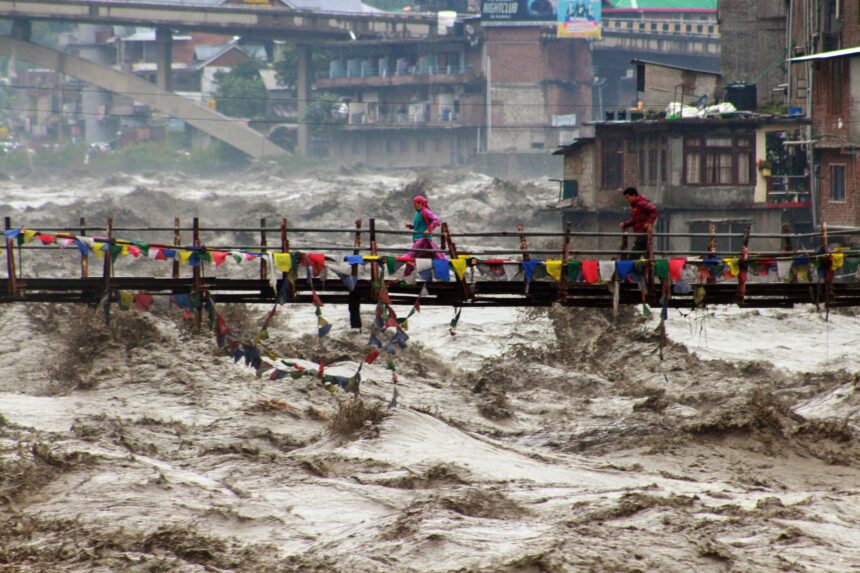
Provincial disaster officials warned that river flows are at their highest levels since 1988, urging residents near Ravi, Chenab, and Sutlej to leave immediately. The flood surge is expected to pass through Lahore overnight, prompting strict monitoring at Shahdara, Khanki, Qadirabad, and Balloki headworks.
Prime Minister Shehbaz Sharif chaired an emergency meeting in Islamabad, directing NDMA and provincial governments to strengthen early warning systems and prevent urban flooding in Lahore, Sialkot, and Gujrat. Federal ministers, including Attaullah Tarar and Ahsan Iqbal, said that water discharge at Khanki has already crossed one million cusecs.
Army deployed in eight districts
In Punjab, the Army has been deployed in Lahore, Kasur, Sialkot, Faisalabad, Narowal, Okara, Sargodha, and Hafizabad, with Army Aviation assisting relief efforts. Officials said over 72 villages in Kasur alone have been evacuated, displacing 150,000 people and 35,000 livestock. Relief camps are providing medical and veterinary care, with 2,600 patients already treated.
Floods have also devastated villages across Okara, Pakpattan, Vehari, Bahawalnagar, and Bahawalpur. Over 130 rescue boats, 1,300 life jackets, 245 life rings, and ambulance bikes have been dispatched to support ongoing missions.
Reservoirs under immense pressure
Water levels remain critical across major rivers and reservoirs. The Indus, Chenab, Ravi, and Sutlej are carrying millions of cusecs downstream, with inflows at Head Marala on the Chenab reaching 902,000 cusecs. Tarbela, Mangla, and Chashma dams are near maximum capacity, holding a combined 11.55 million acre feet of water.
The NDMA has also warned of another spell of heavy rainfall between August 29 and September 9, which could worsen the situation in already flooded catchment areas.
Government pledges full support
PM Shehbaz assured Punjab of the federal government’s complete backing, just as it had extended support to Khyber Pakhtunkhwa during earlier floods. Meanwhile, Planning Minister Ahsan Iqbal accused India of aggravating the crisis by releasing water in stages instead of timely coordination under the Indus Water Treaty.
As Punjab braces for more surging waters, thousands remain in relief camps, waiting anxiously to return home once the rivers calm.