

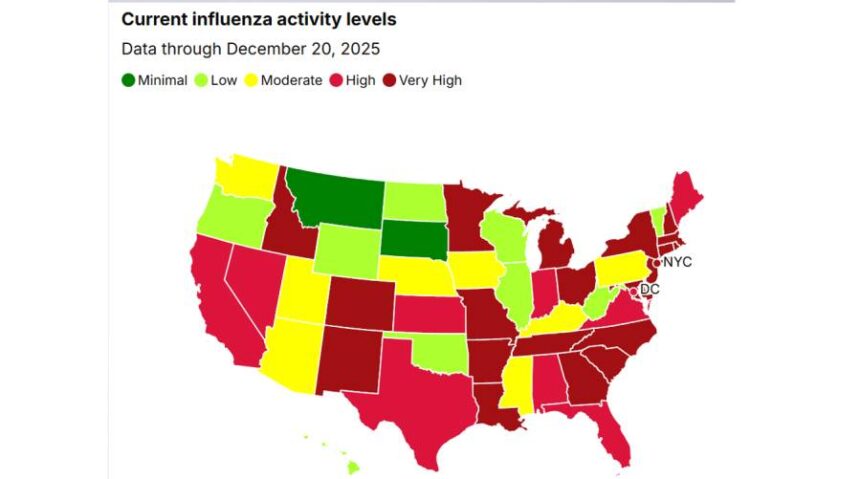
NEW YORK: A rapidly spreading influenza strain has pushed the United States into one of its most severe flu seasons on record, with health officials reporting unprecedented case numbers, rising hospitalizations, and renewed restrictions in hospitals reminiscent of the COVID-19 era.
According to the latest surveillance data from the Centers for Disease Control and Prevention, flu activity surged dramatically in the week ending December 20, with positive tests rising 53 percent from the previous week and nearly 75 percent compared to the same period last year.
Record-breaking flu activity across states
The CDC has classified flu transmission as “very high” in 21 states, with New York City, New York State, New Jersey, South Carolina, Louisiana, and Colorado reporting the most intense spread. New York alone recorded more than 71,000 flu cases in a single week — the highest weekly total ever documented by the state.
Related story: H3N2 subclade K super-flu: How the new, mutated strain is spreading across the world
Hospitalizations have followed a similar trajectory. The number of flu-related hospital admissions rose by 51 percent in just one week, while overall flu hospitalizations have nearly doubled compared to last year. The current hospitalization rate stands at 18.2 per 100,000 people, almost twice the level recorded at this time in 2024.
Children, older adults among the most vulnerable
Tragically, the surge has already claimed young lives. Two children in Kentucky and Alabama died from flu-related complications in recent days, bringing the total number of pediatric flu deaths this season to eight.
Clinicians warn that children often experience sudden symptom onset, sometimes accompanied by vomiting and diarrhea, while adults over 65 remain at the highest risk of severe complications, hospitalization, and death.
Dr. Neal Shipley, medical director at Northwell Health-GoHealth Urgent Care, has urged families to seek immediate care if symptoms worsen rapidly, breathing becomes difficult, or dehydration and weakness develop.
Hospitals reintroduce visitor limits, masking
In response to the escalating spread, several hospitals have reinstated visitor restrictions and masking policies. Duke Health in North Carolina has announced limits on patient visitors beginning January 6, while Iredell Memorial Hospital has barred visitors under the age of 14.
Earlier story: Deadly super flu surge raises alarms across the US
These measures aim to slow transmission of the dominant strain driving the surge — Influenza A (H3N2 subclade K) — a variant experts say is largely unfamiliar to the population’s immune systems.
Why experts fear the surge may continue
Virologists caution that the worst may still lie ahead. Andrew Pekosz, a virologist at the Johns Hopkins Bloomberg School of Public Health, has warned that the trajectory remains unpredictable.
“When you’re in the middle of seeing the curve start to go up, we just don’t know where it’s going to stop,” he noted, echoing concerns shared across medical communities.
The CDC estimates that the current flu season has already resulted in at least 7.5 million illnesses, 81,000 hospitalizations, and 3,100 deaths nationwide.
Vaccination, prevention remain critical
Influenza A strains, including H3N2, account for nearly three-quarters of flu cases this season. Annual flu vaccination remains the most effective preventive tool, reducing the risk of severe illness by 30 to 75 percent.
However, uptake remains modest. As of late November, only about 40 percent of US adults had received the seasonal flu vaccine — a figure unchanged from last year.
Health experts continue to stress basic preventive measures, including vaccination, frequent handwashing, wearing masks in high-risk settings, and avoiding close contact with symptomatic individuals, especially during peak travel and holiday periods.