
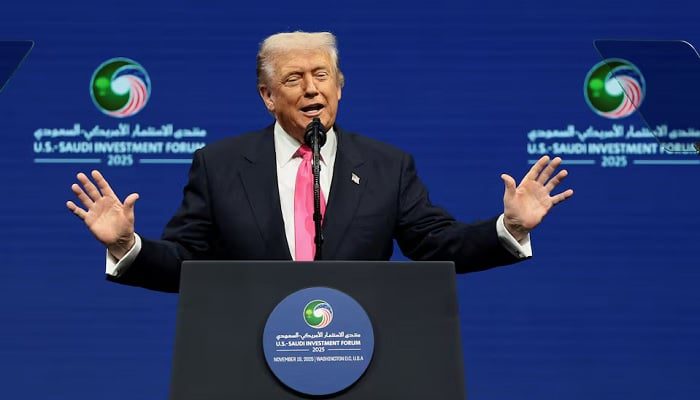
US President Donald Trump has once again claimed that he averted a nuclear conflict between Pakistan and India, telling an audience at the Saudi investment conference on Wednesday that a threatened 350% tariff forced both countries to pull back from the brink of war.
Speaking at the event in Washington, Trump recounted what he described as a moment of imminent nuclear confrontation in South Asia a crisis he said could have killed “millions.” The president explained that both Islamabad and New Delhi were preparing for an armed exchange, and he responded by warning that the United States would impose an enormous tariff on the two countries if they moved ahead.
According to Trump, he told both sides they were free to “go at it,” but that a crushing economic penalty would follow. He said the warning was motivated not only by global security concerns but also by the fear that “nuclear dust” from South Asia could drift as far as Los Angeles. He claimed the leaders of both countries objected, but he insisted he refused to back down.
Trump then said he received a call from Pakistan’s Prime Minister Shehbaz Sharif, who allegedly thanked him and praised him for saving millions of lives. The president added that the appreciation was given “in front of Susie,” a reference to one of his advisers. He further claimed that Indian Prime Minister Narendra Modi phoned him shortly afterwards, informing him that the conflict was over and that India would not be going to war.
For Pakistan, the comments were notable because Trump rarely speaks so directly about his dealings with Islamabad. His remarks came months after Pakistan and India experienced their most serious military confrontation in years, following an attack on tourists in Indian-occupied Pahalgam an incident New Delhi blamed on Pakistan. Islamabad denied involvement and offered to participate in an independent investigation. The escalation included Pakistan shooting down seven Indian fighter jets, including several Rafale aircraft, along with numerous drones. After roughly 87 hours of hostilities, the two sides agreed to a ceasefire brokered by the United States on May 10.
During his Saudi conference speech, Trump shifted briefly to other global disputes, telling the audience that Saudi Crown Prince Mohammed bin Salman had urged him to engage in a Sudan-related conflict he previously had not planned to take on. Trump said the crown prince thanked him for his involvement, prompting him to begin working on the issue.
But Trump repeatedly returned to his broader theme that economic leverage, especially tariffs, had become his most effective tool in resolving conflicts. He boasted that several global disputes were settled because of trade pressure, insisting his approach differed from that of any previous US president.
This narrative is one Trump has revived often. It was the second time during the Saudi crown prince’s visit alone that he repeated his claims. In an earlier appearance at the Oval Office alongside Mohammed bin Salman, Trump declared that he had stopped eight wars worldwide. He said the Pakistan-India conflict was among them, along with interventions in Gaza, Israel-Iran tensions, the Rwanda-Congo standoff, the Ethiopia-Egypt dispute, and the Armenia-Azerbaijan crisis. Trump also highlighted a Gaza agreement he credits himself with brokering, which saw the release of 20 Israeli hostages in exchange for 2,000 Palestinian detainees.
The president concluded by saying he is now turning his focus to Ukraine, insisting that his track record proves he can resolve the world’s most entrenched conflicts through a mix of pressure, negotiation, and economic force.