
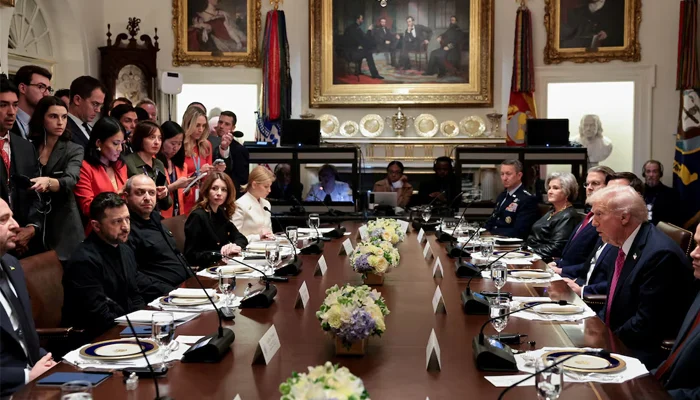
Ukrainian President Volodymyr Zelenskiy arrived in Washington this week hoping to secure advanced U.S. weapons, including long-range Tomahawk missiles, to sustain his country’s fight against Russia. But his meeting with U.S. President Donald Trump suggested a shift — from arming Ukraine to pursuing peace.
During their lunch at the White House, Trump signaled that he was more focused on ending the conflict than expanding Ukraine’s arsenal. “I think President Zelenskiy wants it done, and I think President Putin wants it done. Now all they have to do is get along a little bit,” Trump told reporters, hinting at his desire to broker a ceasefire.
While Trump did not entirely dismiss the idea of providing Tomahawks, he made it clear that the United States must prioritize its own defense. “We want Tomahawks also. We don’t want to be giving away things that we need to protect our country,” he said.
Zelenskiy, candid as ever, reminded Trump that Ukraine’s drone forces were ready but limited by missile shortages. “We don’t have Tomahawks, that’s why we need Tomahawks,” he said. However, following the meeting, he appeared to acknowledge the political reality. “The U.S. does not want escalation,” Zelenskiy told reporters, calling the talks “productive” but “realistic.”
The two leaders also discussed a recent phone call between Trump and Russian President Vladimir Putin. Trump, who has repeatedly cast himself as a dealmaker capable of ending wars, is expected to meet Putin in Hungary within weeks — a summit that could reshape the course of the war.
European capitals are watching closely. Trump’s softer tone toward Moscow has revived fears that Washington might strike a deal more favorable to Russia. A European Union spokesperson cautiously welcomed any talks that could “help bring peace to Ukraine.”
Analysts, however, see Putin’s outreach as a delaying tactic. “The underlying reality is that there is no inclination to impose costs on Russia,” said Michael Carpenter of the International Institute for Strategic Studies. Others, like Max Bergmann of CSIS, believe Moscow’s timing aims to dissuade the U.S. from transferring Tomahawk missiles, which Russia considers a red line.
Zelenskiy continues to count on Washington’s leverage. “President Trump is right — we must stop where we are and then speak,” he said, expressing hope that Trump could pressure Putin to end the war.
Despite recent Russian advances — around 5,000 square kilometers gained in 2025 — Ukraine insists that Moscow’s broader offensive has failed. Still, both nations have intensified strikes on energy infrastructure, and Russian drones have crossed into NATO territory, raising regional alarms.
Trump, who has repeatedly campaigned for a Nobel Peace Prize, seems eager to add another diplomatic success to his list. Whether his approach leads to peace or paralysis remains to be seen.