
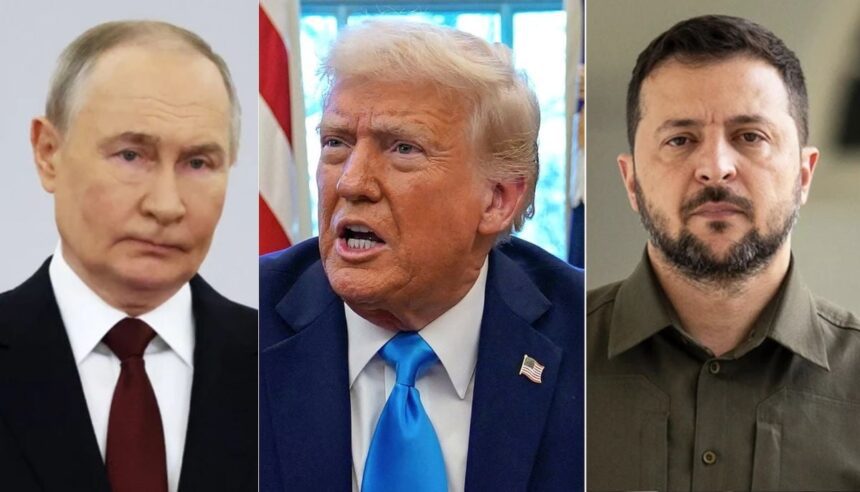
A leaked draft of a 28 point peace plan reportedly prepared by U.S. President Donald Trump outlines a sweeping proposal to end the Russia Ukraine war, offering several concessions to Moscow while reshaping Europe’s future security structure. The U.S. has not officially confirmed the document, and Russia has publicly denied its existence.
According to the draft obtained by the Associated Press, Trump positions himself as a “peacemaker” and lays out a framework requiring Ukraine to give up territory, limit its military, and abandon hopes of joining NATO, while offering Russia gradual reintegration into the global economy.
The plan begins by affirming Ukraine’s sovereignty, followed by a broad non-aggression pact among Russia, Ukraine, and Europe. It requires Russia to halt expansionist ambitions and asks NATO to stop further enlargement. A U.S.-mediated Russia-NATO dialogue would be launched to ease tensions and explore joint economic opportunities.
Ukraine would receive “reliable security guarantees,” but its armed forces would be capped at 600,000 troops. The proposal also demands a constitutional pledge from Ukraine to remain outside NATO, while NATO formally agrees not to admit Ukraine or station troops there. European fighter jets would instead be based in Poland.
The U.S. security guarantee comes with strict conditions:
- Ukraine would lose the guarantee if it attacks Russia,
- Russia would face full sanctions and military retaliation if it violates Ukrainian territory without cause.
The plan also promises Ukraine access to the EU, fast-track economic opportunities, and a major global reconstruction program including tech investment, rebuilding of infrastructure, and joint U.S.-Ukraine gas projects.
In exchange, Russia would gradually be welcomed back into the global financial system. Sanctions could be lifted step-by-step, Moscow could rejoin the G8, and joint U.S.-Russia ventures in energy, AI, Arctic minerals, and infrastructure would be created.
A large portion of frozen Russian assets around $100 billion would be used for Ukraine’s reconstruction, with the U.S. receiving half of the profits. Europe would contribute an additional $100 billion.
On security, both countries would commit to nuclear stability agreements, IAEA-supervised operations at the Zaporizhzhia nuclear plant, and educational programs promoting tolerance, minority rights, and rejection of extremist ideologies.
The most controversial section deals with territory. Crimea, Luhansk, and Donetsk would be recognized “de facto” as Russian. Parts of Kherson and Zaporizhzhia would freeze along current front lines. Ukraine would withdraw from areas of Donetsk it still holds, which would become a neutral buffer zone. Russia would give up some other occupied areas.
Both sides would pledge never to change borders through force. Russia must allow Ukraine to use the Dnieper River and continue Black Sea grain exports.
A humanitarian committee would manage prisoner exchanges, return of civilians and children, and family reunifications. Ukraine would hold elections within 100 days, and all parties would receive full wartime amnesty.
The agreement would be overseen by a new Peace Council led by President Trump, with sanctions for violations. A ceasefire would begin immediately once both sides move to agreed positions.
Despite the detailed plan, officials stress it is not an official U.S. proposal, and Moscow insists the document does not exist.