
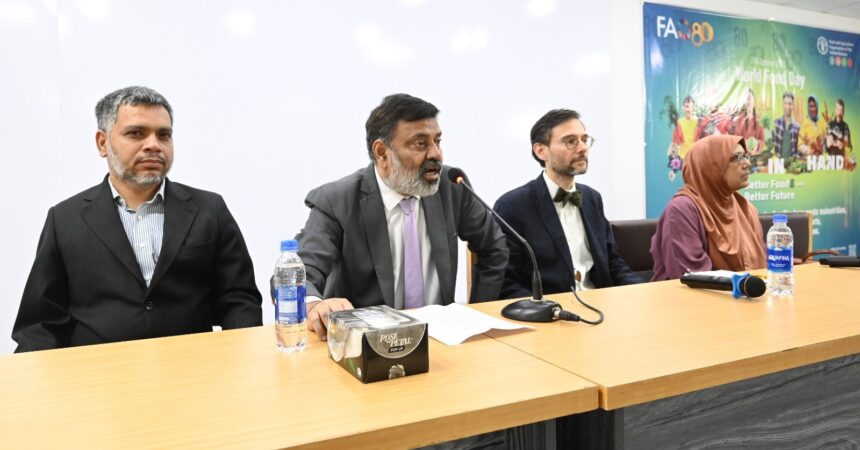
A seminar was organized by the Department of Food Science and Technology, University of Karachi, on the occasion of World Food Day, in which experts expressed deep concern over the food crisis in Pakistan, imbalance in dietary habits, and the failure of agricultural policies.
Vice Chancellor of the University of Karachi, Professor Dr. Khalid Mahmood Iraqi, in his address, said that Pakistan is called an agricultural country, but unfortunately, even today, many essential commodities have to be imported. He stated that our production capacity is either not in accordance with our needs, or due to poor planning and wrong policies, the produce gets wasted before it even reaches the market.
He added that developed countries are producing a higher and better-quality yield on limited land through modern technology, which not only meets their local demands but also strengthens their economies through exports. He emphasized that Pakistan must abandon outdated agricultural practices and adopt modern technology to ensure more effective use of agricultural land.
Associate Professor Dr. Syed Muhammad Ghufran Saeed said in his address that Pakistan is facing a severe food crisis and that unhealthy eating trends have become a serious threat to public health. He pointed out that Pakistanis consume 22 to 24 kilograms of fat per capita annually, which is among the highest levels in the world. According to him, the excessive consumption of fats, sugar, salt, and trans fats is increasing heart diseases, high blood pressure, and other ailments, which also negatively affect the economy.
Dr. Pedro Andres Garzon Delvaux, Food Systems and Environmental Economist at the Food and Agriculture Organization (FAO), said that Pakistan is rapidly becoming an urbanized country, with a 1 percent increase in the rural population and a 2.35 percent increase in the urban population. He noted that the food sector has multifaceted effects on the economy and that the interconnection between public and private interests offers numerous opportunities for growth.
Chairman of the Department of Food Science and Technology, Professor Dr. Abdul Haq, stated that post harvest losses in developed countries are less than 10 percent, while in Pakistan, they reach up to 30 percent, highlighting the lack of adequate infrastructure. He mentioned that Brazil processes 70 to 80 percent of its fruit into juice, while Pakistan processes only about 3 percent of its fruits into value added products.
Dean of the Faculty of Science, Professor Dr. Musarrat Jahan Yousuf, in her address, said that World Food Day reminds us that improvements in food production, safety, and nutrition are key to ensuring a secure and healthy future.
Professor Dr. Nusrat Jabeen and other experts also addressed the seminar. The speakers agreed that there is an urgent need to reduce food wastage, adopt modern technology, and bring balance to dietary habits in order to ensure a healthy and nutritious future for the nation.